
CUCUMBER GUIDE
National Pickling Cucumber Growing Guide
Grow National Pickling for frequent harvests of small, firm cucumbers. Learn planting, pollination, harvest sizes, planning pickle batches, common problems and seed saving.
CucumbersVariety guideBeginner → advanced
Published by Hollowstead Seed Co. · How this guide is prepared
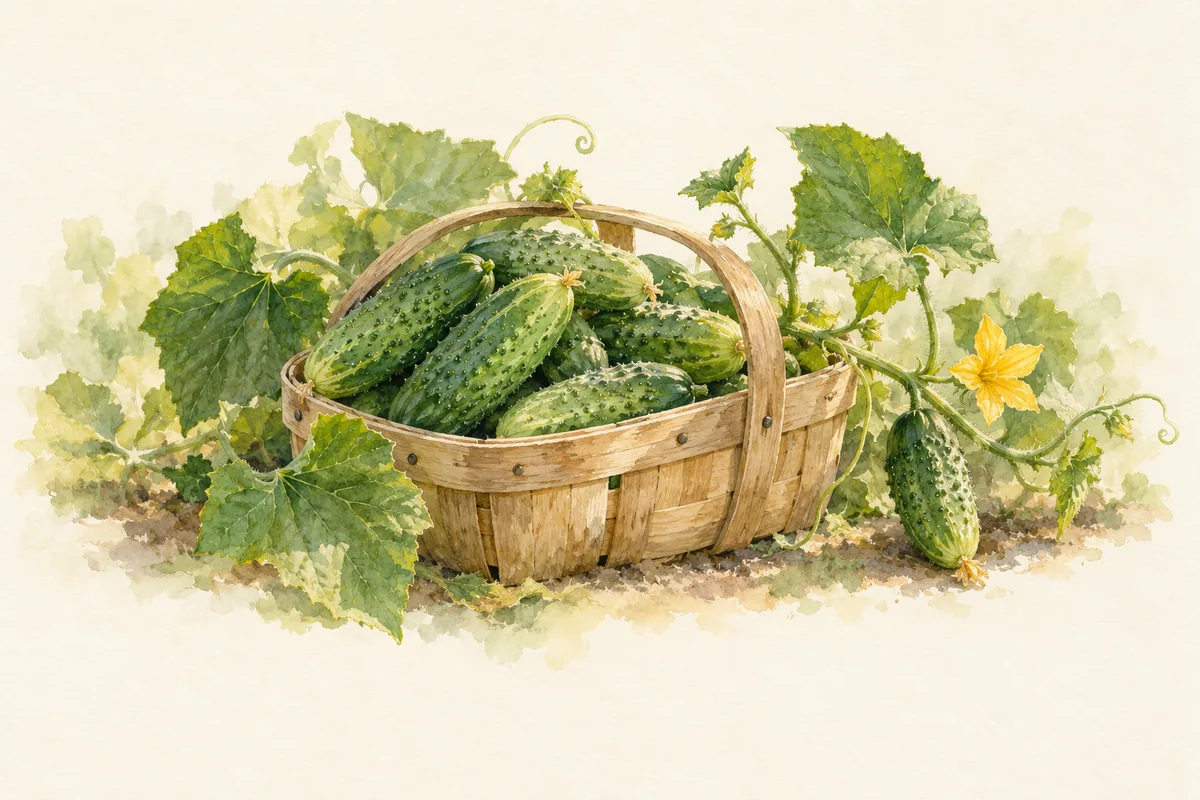
Quick answer
National Pickling suits the gardener who wants to pick small, firm green cucumbers frequently. Let your intended recipe set the harvest size: tiny fruit for little pickles, or roughly 4–5-inch fruit for many dill-style uses. The packet’s about 50–70 days from sowing estimates when harvest begins; it does not tell you how long an individual cucumber should stay on the vine.
Give these warm-season vines sun, steady moisture and pollinator access. Check them often once fruit begins growing. A cucumber missed for several days can move beyond the size you wanted even while the vine looks much the same.
At a glance
| Planning point | Useful starting point |
|---|---|
| Botanical name | Cucumis sativus |
| Type | Open-pollinated pickling cucumber; vining |
| Packet | 20 seeds |
| Sow / germination | 1 inch deep; about 6–10 days in warm conditions |
| Final spacing | 18–24 inches; allow room for support and access |
| Light | Full sun |
| First harvest estimate | About 50–70 days from sowing |
| Picking priority | Firm green fruit in the size your recipe specifies |
SAVE FOR SOWING DAY
Five-step crop plan for National Pickling
Open the sow-to-harvest plan
- StartDirect sow 1 inch deep after frost in warm soil; keep the seedbed evenly moist until emergence. Guide details
- PlantThin to 18–24 inches and provide an anchored trellis or clear growing space with access for frequent picking. Guide details
- MaintainKeep root-zone moisture steady through fruiting and remove insect covers when flowers need bees; check both male and female blooms. Guide details
- HarvestPick firm green fruit at the size your tested recipe requires; about 2 inches suits small pickles and 4–5 inches is a dill-size planning target. Guide details
- Next sowing or seedIsolate from other cucumbers or hand-pollinate protected flowers; reserve overmature seed fruit, then extract, ferment, rinse, dry fully and label. Guide details
- Space
- Use 18–24-inch plant spacing with a trellis or managed vine area; reserve wider room for trailing vines and an unobstructed picking route.
- Timing
- Hollowstead lists about 50–70 days from sowing to first useful fruit; the chosen pickle size, warmth and pollination affect actual harvest.
Full growing guidehttps://hollowsteadseeds.com/national-pickling-cucumber-growing-guide/Seed packethttps://hollowsteadseeds.com/product/national-pickling-cucumber-seeds/Find planting dates by ZIP code
Plan the harvest before planting
A pickling variety is useful only if its harvest fits your kitchen routine. Think about whether you want a few cucumbers for a refrigerator recipe or enough of a matching size for a larger preservation session. A seed packet contains potential plants, not a promise that a particular number of plants will fill a particular number of jars.
Begin with the bed area and the time you can give it. If you visit the garden every day, you can make good use of small fruit. If you can only pick occasionally, the smallest sizes will be harder to catch consistently. Keep a bowl or basket by your picking route, and mark the length you want on a small washable reference card.
For more than one planting, use your first sowing to learn the local pace before committing the entire packet. A later sowing may extend opportunity when the season is long enough, but it also needs warm establishment time and enough growing season ahead. Compare this role with Marketmore 76 if fresh slices are your main goal.
Sowing and establishment
Plant after frost once the seedbed is warm. A target around 70°F at seed depth is a useful, conservative starting point for garden cucumbers.[1] Do not sow into a cold wet bed simply because the daytime air feels pleasant.
Plant 1 inch deep and keep the seed zone consistently moist. If you sow extra seeds, thin the plants once you can identify a healthy keeper. Snipping the extras at soil level avoids tugging on nearby roots. The final packet spacing is 18–24 inches for a managed vine area or trellis; leave additional space for paths and for vines grown along the ground.
Transplants can give a head start when handled gently. Start only a few weeks ahead, use individual cells or small pots, and move young plants with their root balls intact. Illinois Extension cautions that large or bare-root cucumber transplants establish poorly.[2]
At planting, label the row with variety and date. If another cucumber grows nearby, place the marker where you can still read it after vines overlap. Distinguishing two seedlings is much harder than distinguishing their packets.
Vines, water and containers
Put support in place before the vines need it. National Pickling can climb a secure trellis or spread across a dedicated patch. A trellis is especially convenient for the frequent checks that small-pickle harvest requires: you can see both sides of the canopy and lift a leaf without moving the whole plant.
Do a reach test before planting. Can you see and touch the back of the support? Can you bring a basket past it without brushing the vines? A planting that looks efficient on paper may become awkward when leaves and fruit fill every opening.
Maintain steady root-zone moisture, especially once fruit is developing. Keep the ground draining freely and avoid repeated drought-and-soaking cycles. Iowa State’s cucumber guidance emphasizes regular water and offers trellising as a way to use space and improve access.[3] Use fertilizer according to the soil test or container label; more feed is not a substitute for water.
In a container, use potting mix, drainage and enough soil volume for the vine you intend to grow. Brace the support separately if necessary. Place the pot where watering is convenient, because a heavy fruiting plant is not a good candidate for frequent relocation. The container cucumber guide covers setup in detail.
Flowers and pollination
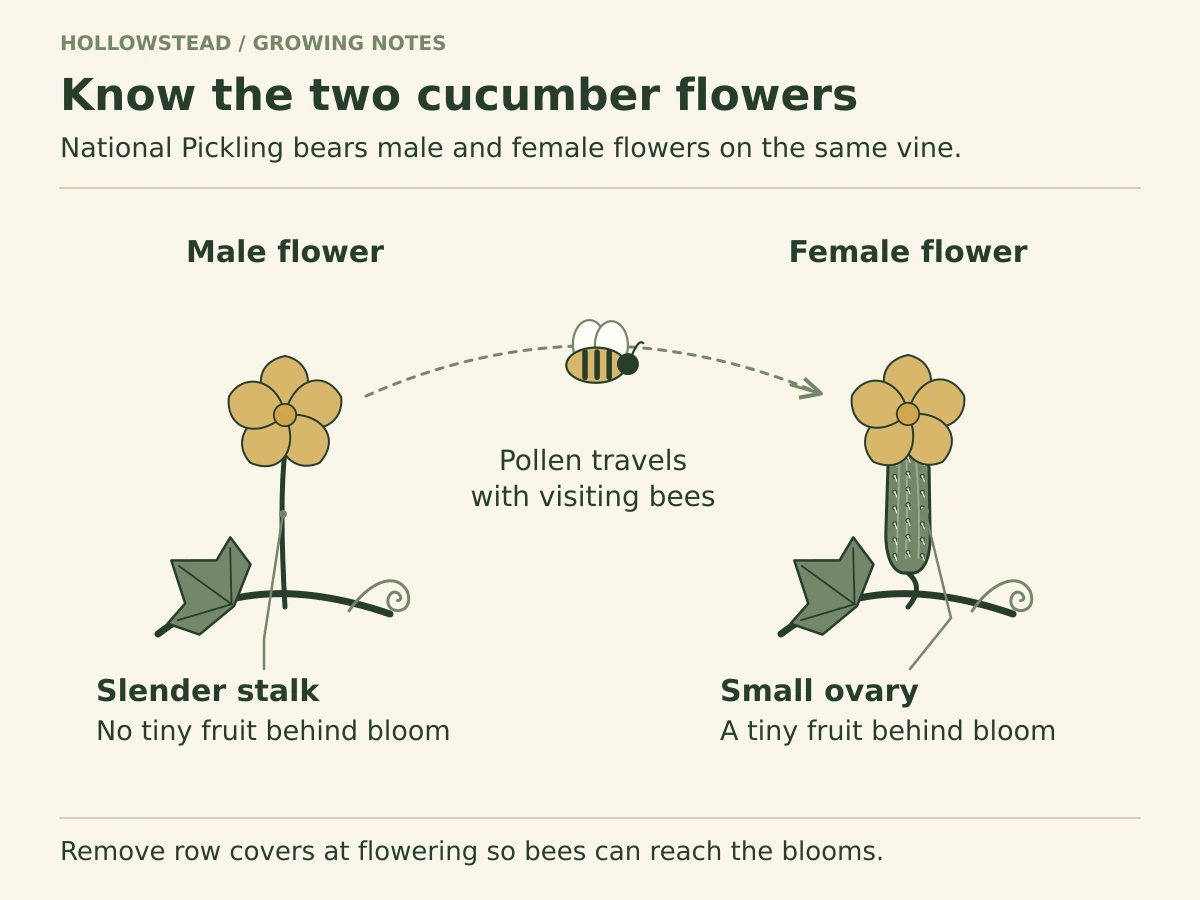 View full-size diagram
National Pickling has separate male and female flowers on the same plant. The female flower sits above a tiny cucumber-shaped ovary; male flowers provide pollen. A single plant can carry both kinds, but pollen still needs to move between them.
Maryland Extension explains the role of bees in garden cucumber pollination and notes that male flowers commonly appear first.[4] Seeing the first blossoms fall is therefore not, by itself, a crop failure. Watch for female flowers and whether the little fruit behind them begins to enlarge.
Remove insect-excluding covers when flowers need pollinators. If you use protected growing space, plan hand pollination or another suitable way to get pollen to flowers. Poorly pollinated fruit may fail to enlarge or develop an uneven shape.[5] Check weather, flower access and visits before assuming that misshapen fruit means the variety is wrong.
If your goal is saved seed, hand pollination has an additional requirement: protect flowers from unwanted pollen before and after the controlled pollination. Simply brushing pollen onto an already-open flower does not prove which pollen fertilized its seeds.
Harvesting for the pickle you want
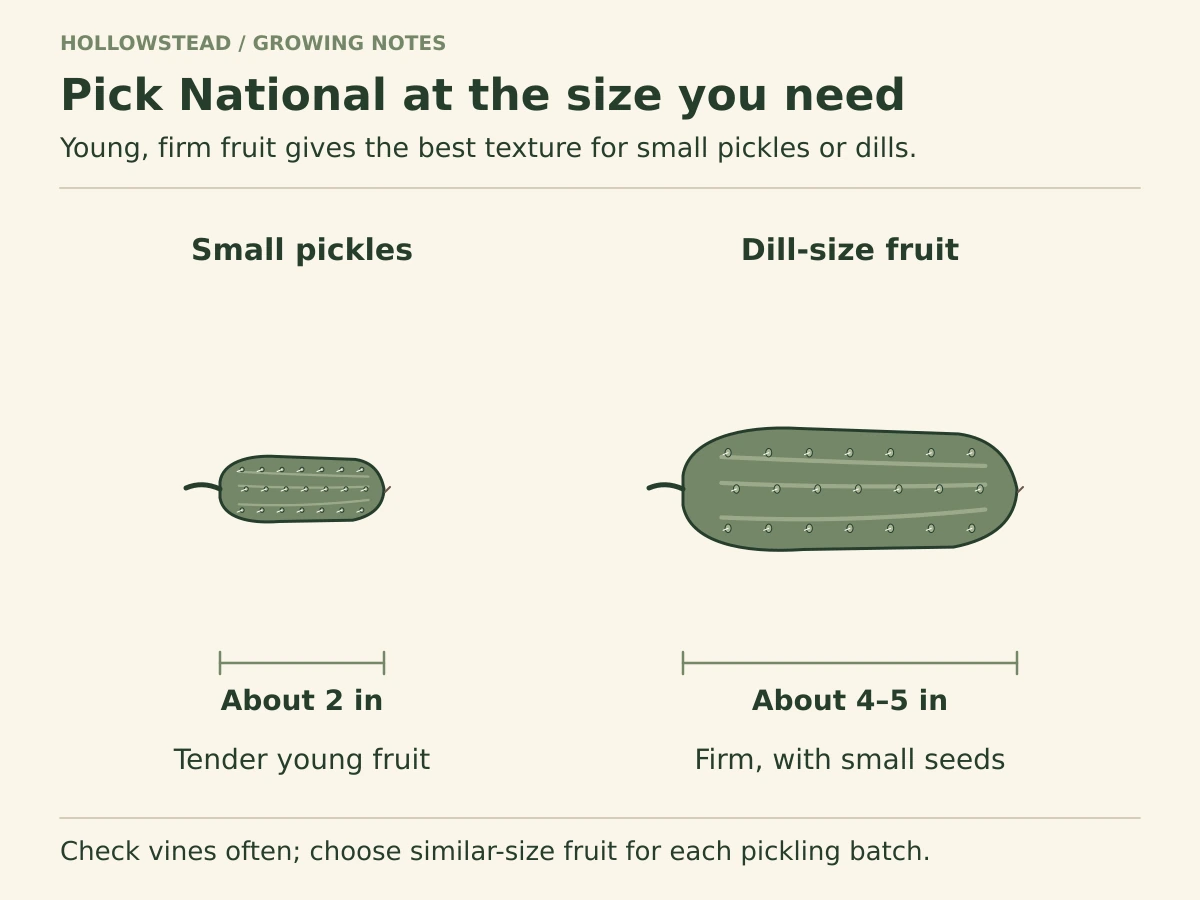 View full-size diagram
For general garden planning, about 2 inches is a useful small-pickle stage and about 4–5 inches a useful dill-size stage. Illinois gives small-pickle and dill ranges; the National Center for Home Food Preservation gives its own recipe-oriented examples, including approximately 1½-inch gherkins and 4-inch dills.[2][6] These are selection cues, not a direction to change a recipe’s specified size.
Use several signs together: length, firmness, green color and a seed cavity that has not become coarse. A short, swollen fruit can already be older than a longer, slender one. Slice a sample when learning the variety.
Clip the stem without pulling against the vine. Work through a section in the same order each time: near side, far side, then beneath the lowest leaves. Daily checks are especially useful when aiming for very small fruit.[2] Put oversize fruit in a separate basket so it is not accidentally packed into a batch chosen for another size.
From garden to kitchen
Keep newly picked cucumbers out of direct sun and use them promptly. Sort by size and condition before starting a recipe. The National Center for Home Food Preservation recommends firm cucumbers of the appropriate size; larger or irregular fruit may fit a different tested relish or sliced-pickle recipe.[6] Soft, decaying fruit should not be rescued by pickling.
For shelf-stable pickles or fermented pickles, follow a tested recipe through ingredient proportions, cucumber preparation, container and processing directions. Do not improvise the vinegar-to-water ratio from how sour the brine tastes. National Center guidance specifically warns against altering those proportions and describes removal of the blossom end.[7]
National Pickling can also be eaten fresh. A cucumber picked for a salad does not need to be sent to a jar because “pickling” is in its name. Use the smallest, best-matched fruit for the project that needs uniformity and enjoy other sound fruit fresh if its texture suits you.
Common problems and what to check
Inspect the planting before the damage becomes extensive. Seedlings are easy to examine; a large tangled canopy hides stems and leaf undersides. Keep your observations specific: holes, white coating, angular lesions, or a vine that suddenly wilts require different investigations.
| Problem | Useful check | First response |
|---|---|---|
| No seedlings | Seed-zone temperature and moisture | Correct cold, dry or saturated conditions before resowing. |
| Chewed young leaves | Presence of striped or spotted cucumber beetles | Identify the insect and choose a locally appropriate control. |
| Wilt despite moist soil | Stem injury or a disease pattern | Consult a diagnostic guide; repeated watering may worsen saturated soil. |
| Fruit becomes yellow and seedy | Whether it was missed during harvest | Remove it unless deliberately reserved for seed. |
| One end fails to fill | Pollination, stress and physical obstruction | Review flowers and growing conditions; watch the next fruit. |
Maryland’s cucumber problem key covers beetles, wilt and leaf diseases.[8] If the cause is uncertain, photograph both sides of the affected leaves and the entire vine. Note whether neighboring cucumber plants show the same problem and whether symptoms appeared suddenly or spread gradually.
Saving National Pickling seed
Seed fruit must stay on the vine far beyond the green eating stage. Reserve healthy, typical fruit and clearly mark it so nobody picks it for the kitchen. The fruit will enlarge, change color and soften as its seed matures; a good pickle-size cucumber does not yet contain fully mature planting seed.[9]
Other varieties of Cucumis sativus, including Lemon and Marketmore 76, can cross with National Pickling. Seed Savers Exchange recommends substantial separation or controlled pollination with protected blossoms when saving a named variety. Extract mature seeds, briefly ferment the pulp, rinse and dry the seeds thoroughly before storage.[9]
Keep selection, pollination and processing notes together. If you cannot protect variety identity this year, enjoy the crop for food and start the next crop with known seed. Saving an experimental cross is also possible, provided it is labeled as an experiment rather than distributed as National Pickling.
GROW FROM SEED
Grow this variety
National Pickling Cucumber Seeds come in a 20-seed packet. Use the three-variety cucumber comparison to plan a mix for fresh eating and pickling.
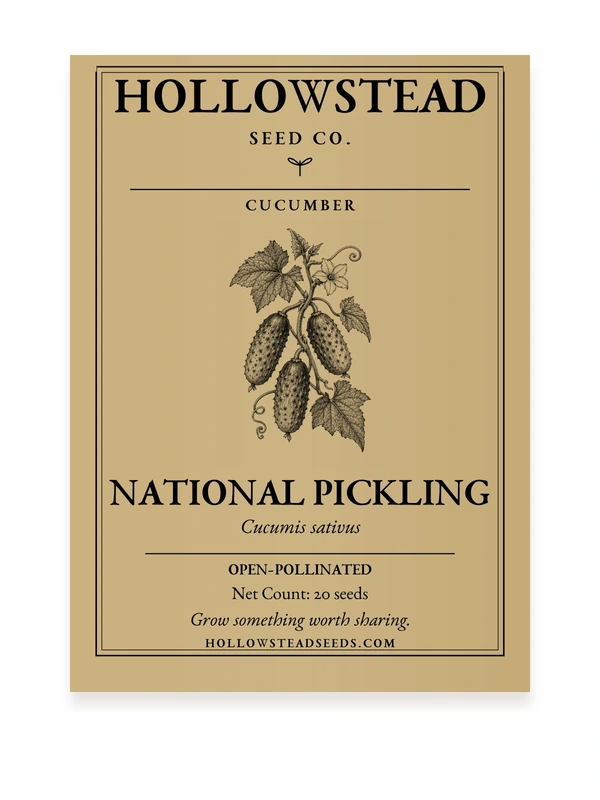
HOLLOWSTEAD SEED
National Pickling Cucumber Seeds
$3.99
HOLLOWSTEAD SEED
Marketmore 76 Cucumber Seeds
$3.99Frequently asked questions
Can I eat National Pickling cucumbers raw?
Yes. Harvest sound, firm green fruit while its texture is tender. “Pickling” describes a useful type and purpose, not a requirement to preserve every cucumber.
What size is best for National Pickling?
Choose the size your intended use requires: roughly 2 inches for small pickles or 4–5 inches for many dill-style uses. A tested recipe’s size directions take priority.
Does it need another variety to pollinate it?
No. A plant has male and female flowers, but pollen must still move between them, generally by bees. Another variety is not required.
Can I pickle yellow overgrown fruit?
Choose firm fruit at the stage required by a tested recipe. Yellow, soft or very seedy fruit has passed the usual high-quality pickle stage.
Why is the maturity range so broad?
The 50–70-day packet window is a planning estimate from sowing. Conditions and the fruit size you choose to pick affect when usable harvest begins.
Can I save seeds from a jar-size cucumber?
Usually not successfully: eating-stage cucumbers are immature. Seed saving requires deliberately reserved fruit allowed to mature much longer and a plan to prevent unwanted crossing.
Sources & further reading
- University of Minnesota Extension. Growing cucumbers in home gardens. https://extension.umn.edu/garden-and-home/yard-and-garden/gardening-in-minnesota/growing-cucumbers
- Illinois Extension. Cucumber: Home Vegetable Gardening. https://extension.illinois.edu/gardening/cucumber
- Iowa State University Extension and Outreach. Growing Cucumbers in the Home Garden. https://yardandgarden.extension.iastate.edu/how-to/growing-cucumbers-home-garden
- University of Maryland Extension. Growing Cucumbers in a Home Garden. https://extension.umd.edu/resource/growing-cucumbers-home-garden
- University of Minnesota Extension. Fruits and vegetables that require pollination. https://extension.umn.edu/agriculture/specialty-crops/pollination/requirements
- National Center for Home Food Preservation. Selection of Fresh Cucumbers. https://nchfp.uga.edu/how/pickle/general-information-pickling/selection-of-fresh-cucumbers/
- National Center for Home Food Preservation. General Information on Fermenting. https://nchfp.uga.edu/how/ferment/general-information-on-fermenting/general-information-on-fermenting/
- University of Maryland Extension. Key to Common Problems of Cucumbers. https://extension.umd.edu/resource/key-common-problems-cucumbers
- Seed Savers Exchange. Growing and saving cucumber seeds. https://seedsavers.org/grow-cucumber/
Hollowstead Growing Notes
A little help for your next growing season
Practical sowing advice, help choosing seeds, and occasional Hollowstead shop news. Usually one or two emails a month, plus a short welcome note.
Choose your topics and frequency after you confirm. Our guides and planting calendar are always free.