
CONTAINER GUIDE
Growing Flowers in Containers
Grow annual flowers in containers by matching mature plant size to root volume, drainage, potting mix, sun, watering, fertility, support, and a crop-specific container strategy.
FlowersContainer guideBeginner → advanced
Published by Hollowstead Seed Co. · How this guide is prepared
Quick answer
Container flowers succeed when the pot is large enough for the mature root system, has open drainage holes, contains a quality soilless potting mix, receives the light the flower needs, and is checked for water often enough to prevent extreme wet-dry swings. Calendula is easy to fit; tall Sensation cosmos and Lemon Queen sunflower need much larger, heavier containers and support.[1][2]
The pot is part of the growing environment. A plant that would have several cubic feet of root zone in the garden cannot be managed the same way in a small decorative container.
At a glance
| Factor | Useful starting point |
|---|---|
| Drainage | Multiple unobstructed holes |
| Medium | Quality soilless container mix |
| Sun | 6+ hours; more for heavy bloom |
| Water | Check frequently in heat and wind |
| Fertilizer | Measured, regular container program |
| Support | Anchor tall plants before they are top-heavy |
| Container stability | Wide/heavy enough not to tip |
- Root volume
- Match pot to mature plant, not seedling size
- Drainage
- Water must be able to leave
- Mix
- Use container medium, not dense yard soil
- Water
- Hot small pots can need daily attention
- Nutrition
- Small root zones have limited reserves
- Wind
- Tall plants need both stem support and a stable pot
Choose a container by mature plant, not by transplant
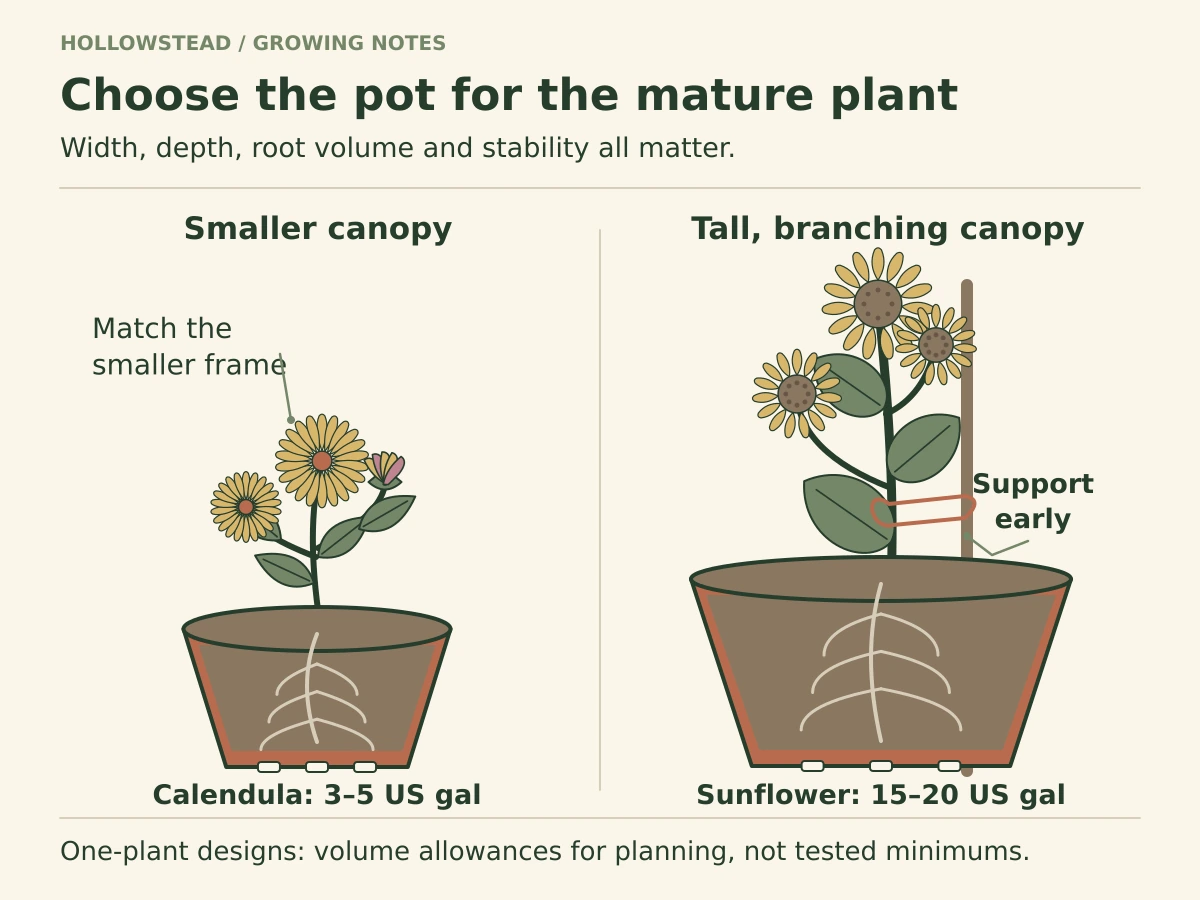
A newly transplanted flower can make almost any pot look enormous. The useful question is how much root system and top growth the container must support in July. Illinois Extension recommends choosing a container large enough for the mature plants and ensuring that drainage holes are present.[2]
Wider, heavier pots also resist tipping. That matters for a 4-foot cosmos or a branching sunflower whose leaves and flowers become a sail in thunderstorms. If a container needs a stake, anchor the stake into the potting volume while roots are still small rather than driving it through a mature root ball later.
Use potting mix and protect drainage
Illinois Extension recommends a soilless potting mix based on materials such as peat or coir with mineral components that improve drainage.[2] Garden soil alone is usually too dense for a container, especially after repeated watering compacts it.
Do not create a “drainage layer” that blocks or reduces usable root volume. What matters is an appropriate mix plus open holes that let excess water exit. Elevate pots slightly if the patio surface seals holes shut.
Plan for the full-size flower
- Conservative home-garden designs, one plant per pot: Zeolights Calendula 3–5 US gal; California Giant Mix Zinnia 5+ US gal.
- Sensation Mixture Cosmos 7–10 US gal; Lemon Queen Sunflower 15–20 US gal, with support and a stable base.
- Usable depth: calendula 10–12 in; zinnia about 12 in; cosmos 14–16 in; sunflower about 18 in. These are planning allowances, not tested minimums.
- Use potting mix and open drainage. Account for existing mix fertilizer, then follow the container-feed label; no universal feeding interval.
Match root volume to the mature plant
There is no honest one-size pot recommendation for all four Hollowstead flowers. Use mature height, width, wind exposure, and water demand to choose the container.
Combining flowers is possible when their light, water, and mature-size needs overlap. Do not use the nursery “thriller-filler-spiller” idea as an excuse to pack four full-size cutting crops into one small pot.
Container watering and feeding require observation
Containers have limited medium and can dry rapidly in summer. Missouri Extension notes that daily watering may be necessary for annuals in containers during hot conditions, and Illinois Extension likewise warns that small pots dry much faster than large ones.[3][2] Water thoroughly until excess drains, then check moisture before watering again rather than adding a ceremonial splash on a schedule.
Nutrients also leave with drainage water. Use a measured fertilizer program appropriate to the potting mix, crop, and label. Avoid heavy nitrogen that produces oversized foliage and weak flower production. Cosmos in particular is not improved by turning the container into a high-fertility feeding experiment.
Support, heat, and placement
Place pots where they receive the direct sun required for heavy flowering, but remember that container roots experience more temperature fluctuation than roots in the ground. Dark pots in reflected afternoon heat can become much hotter than the surrounding air.
Support tall stems and stabilize the container itself. A stake tied beautifully to a sunflower does not help if the entire pot tips over. Grouping large containers can reduce wind exposure, but do not crowd foliage so tightly that disease-prone leaves stay damp.
Container flower troubleshooting
Container plans for these varieties
For the disease row above, wet foliage and splash can contribute to some leaf spots. Powdery mildew can also develop on dry zinnia leaves, so improve airflow and inspect symptoms rather than diagnosing every white patch as an overwatering problem; see the zinnia disease discussion.
These are conservative home-garden starting designs, not experimentally established minimum volumes or guarantees of mature size. US gallons describe mix capacity, not nursery trade-pot labels. Check both actual usable depth and width; a tall narrow vessel can have enough volume yet tip easily. Increase volume in hot, windy sites and keep drainage open.
| Variety | Starting container | Plant count | How to use it |
|---|---|---|---|
| Zeolights Calendula | 3–5 US gallons; about 10–12 inches deep | 1 plant | Most manageable of this group on a patio. |
| California Giant Mix Zinnia | 5 US gallons or more; about 12 inches deep | 1 plant | Full-size cutting plant; stake if exposed. |
| Sensation Mixture Cosmos | 7–10 US gallons; about 14–16 inches deep | 1 plant | Large, stable pot plus support; leave room around the canopy. |
| Lemon Queen Sunflower | 15–20 US gallons; about 18 inches deep | 1 plant | Demanding container project; anchor pot and stems, with daily moisture checks in heat. |
For example, if a new potting mix already contains a starter fertilizer, do not immediately add a second full feeding. Note the period stated on the mix bag; when that supply is used up, choose a fertilizer labeled for the crop and containers and follow its dilution and interval. If the mix has no fertilizer, follow the container-product label from establishment. Water the root ball first if dry, and avoid adding extra phosphorus simply because flowers are slow.
GROW FLOWERS ANYWHERE
Build a container that fits the plant.
Containers make flowers possible on patios and small spaces, but the mature plant still sets the rules for root volume, water, support, and light.
HOLLOWSTEAD SEED
Lemon Queen Sunflower Seeds
$3.99
HOLLOWSTEAD SEED
Sensation Mixture Cosmos Seeds
$3.99
HOLLOWSTEAD SEED
California Giant Mix Zinnia Seeds
$3.99
HOLLOWSTEAD SEED
Zeolights Calendula Seeds
$3.99KEEP LEARNING
Related Hollowstead guides
SEED STARTING
Growing Four Annual Flowers From Seed
Grow annual flowers from seed with a crop-by-crop plan for sowing, germination, thinning, transplanting, soil preparation, watering, pinching, bloom care, cutting, troubleshooting, and seed saving.
Read the guide
TROUBLESHOOTING
Why Flowers Don’t Bloom — or Bloom Poorly
Troubleshoot weak or missing flowers in a logical order by checking maturity, season, sun, water, roots, fertility, spacing, weather, pests, disease, and harvest practices.
Read the guide
FLOWER CARE
How to Deadhead Flowers for More Blooms
Deadhead annual flowers more precisely by learning where to cut, how each crop responds, how often to revisit plants, what diseased material to remove, and when to stop for seed saving.
Read the guideFrequently asked questions
Can I grow Lemon Queen sunflower in a pot?
Yes, but it is the most demanding Hollowstead flower for containers. Use a very large, heavy pot with strong support and reliable watering.
Can Sensation cosmos grow in containers?
Yes, but its tall habit means a large stable container and support are much more practical than a small decorative pot.
How often should I water flower pots?
There is no fixed schedule. Check moisture often; small pots in hot windy weather may need daily watering while large pots may not.
Should I fill the bottom of a pot with rocks?
No drainage trick replaces open holes and an appropriate potting mix. Preserve usable root volume and let excess water leave the container.
Can I use garden soil in pots?
A quality soilless container mix is more predictable because it maintains air space and drainage through repeated watering.
Sources & further reading
- University of Maryland Extension Care of Annuals and Perennials https://extension.umd.edu/resource/care-annuals-and-perennials
- Illinois Extension Gardeners Corner Summer 2021 https://extension.illinois.edu/newsletters/gardeners-corner/gardeners-corner-summer-2021
- University of Missouri Extension Flowering Annuals: Characteristics and Culture https://extension.missouri.edu/publications/g6629
- Seed Savers Exchange Growing and Saving Flower Seeds https://seedsavers.org/learn/growing-guides/growing-and-saving-flower-seeds/
Hollowstead Growing Notes
A little help for your next growing season
Practical sowing advice, help choosing seeds, and occasional Hollowstead shop news. Usually one or two emails a month, plus a short welcome note.
Choose your topics and frequency after you confirm. Our guides and planting calendar are always free.