
TRELLISING
How to Trellis Pole and Yardlong Beans
Build bean support before the vines need it. Compare teepees, row trellises, panels, and arches; learn how tall to build for pole versus yardlong beans; and plan anchoring, training, spacing, and harvest access.
BeansSupport guideBeginner → advanced
Published by Hollowstead Seed Co. · How this guide is prepared
Quick answer
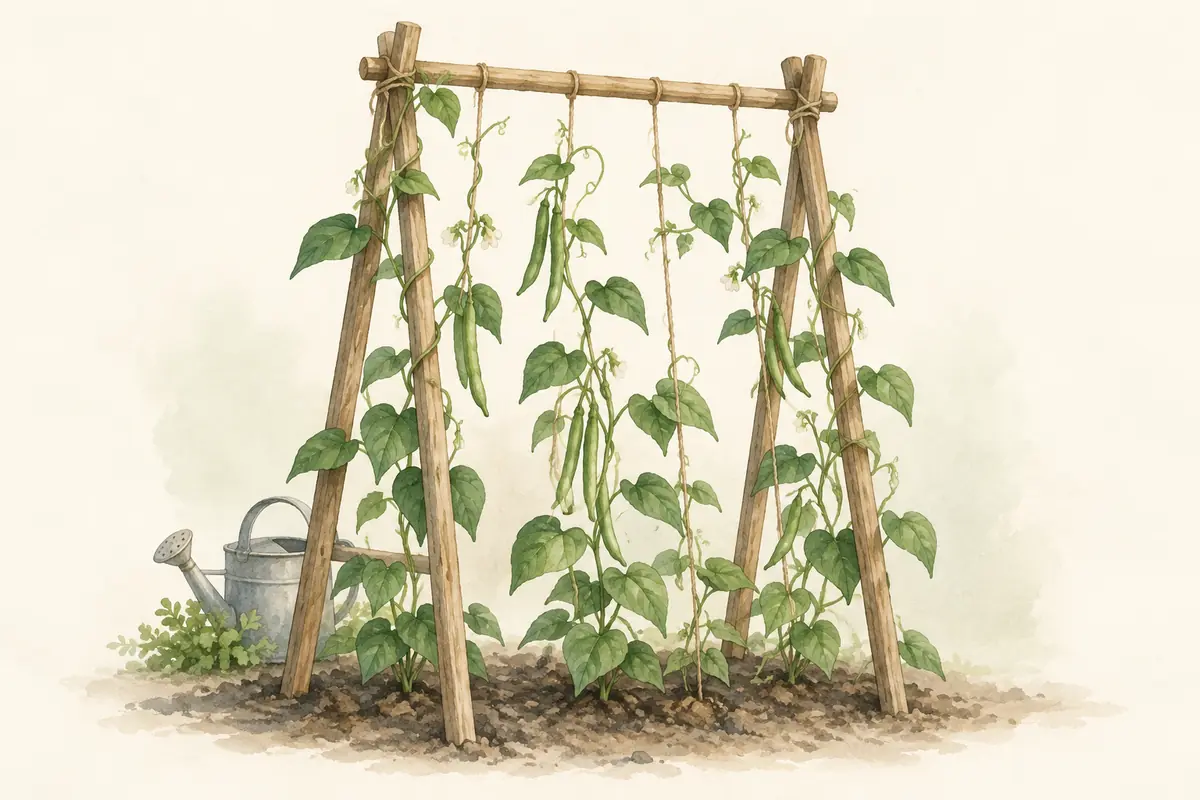
Build the trellis before the beans need it. Maryland recommends sturdy supports about 6–8 feet tall for pole beans, and UF/IFAS reports yardlong vines that can reach 9–12 feet even when managed on a 6-foot trellis.[1][3]
The best trellis is not the tallest possible structure. It is the structure that stays anchored in wet soil and wind, gives vines something they can twine around, and lets you reach the crop without crushing the root zone.
Trellis at a glance
| Pole beans | 6–8 ft is a common Extension recommendation |
|---|---|
| Yardlong vines | Can exceed the trellis and run 9–12 ft |
| Install | Before or at planting |
| Best material | Anything sturdy with climbable vertical elements |
| Main failure | Weak anchoring after rain + wind + mature vine weight |
- Height
- 6–8 ft common target
- Anchor
- Design for wet-soil wind load
- Climb surface
- Vertical strings, poles, mesh or panel
- Access
- Reach pods from path
- Cleanup
- Remove diseased vines before storage
A worked six-foot bean row
For a manageable Red Noodle trial, allocate a 6-foot-long × 2-foot-wide bed strip with a 3-foot picking lane. Before sowing, install two end posts plus one center post, with about 6 feet exposed above soil. Use sound exterior timber or purpose-made steel posts and fasten a strong top rail or tensioned top wire with hardware rated for the materials. Add diagonal end bracing or guy anchors outside the walking route. Embed posts to the hardware maker’s guidance for your soil and wind exposure; if they rock under a firm hand push, correct the anchoring before planting.
Fix climbing mesh with about 6-inch openings, or vertical twine at 6-inch intervals, securely to top and bottom supports. Leave no sharp wire ends. Sow 1 inch deep in one row, keeping 12 final plants at 6-inch spacing, with the end plants 3 inches inside the bed ends. Thin extra seedlings at soil level. Guide runners early and route extra growth along the top or let it drape within reach; a 9–12-foot vine does not require climbing a ladder to harvest.
This is a home-garden layout, not a structural load rating. In exposed sites use a manufactured trellis with suitable anchoring or strengthen the frame for the site. Recheck ties and posts after wind and heavy rain.
Choose a trellis by vine and garden
How tall should a bean trellis be?
Maryland and Clemson both recommend roughly 6–8 feet for pole-bean trellises.[1][2] Yardlong vines can exceed that; UF/IFAS reports plants 9–12 feet tall but still uses a 6-foot trellis as a practical support system.[3] In a home garden, extra vine can be guided sideways, across the top, or allowed to drape where harvest remains reachable.
A 10-foot structure is not automatically better if you need a ladder to pick it. Design for your reach and maintenance style.
Option 1: a teepee or pole tripod
A teepee uses three or more poles tied firmly near the top. Clemson describes planting several seeds around each pole of a tripod.[2] The geometry is naturally stable and works well for a small number of pole beans.
Bean teepee layout and sowing guidance
- Anchor poles firmly, secure the top, and leave access around the base. Sow the stocked beans about 1 inch deep, then thin to the packet spacing.
Option 2: a row trellis
A row system uses strong end posts with netting, wire panel, or vertical strings between them. It scales better than a teepee for a long row and usually provides better airflow and harvest access because pods hang along a plane instead of into a dense cone.
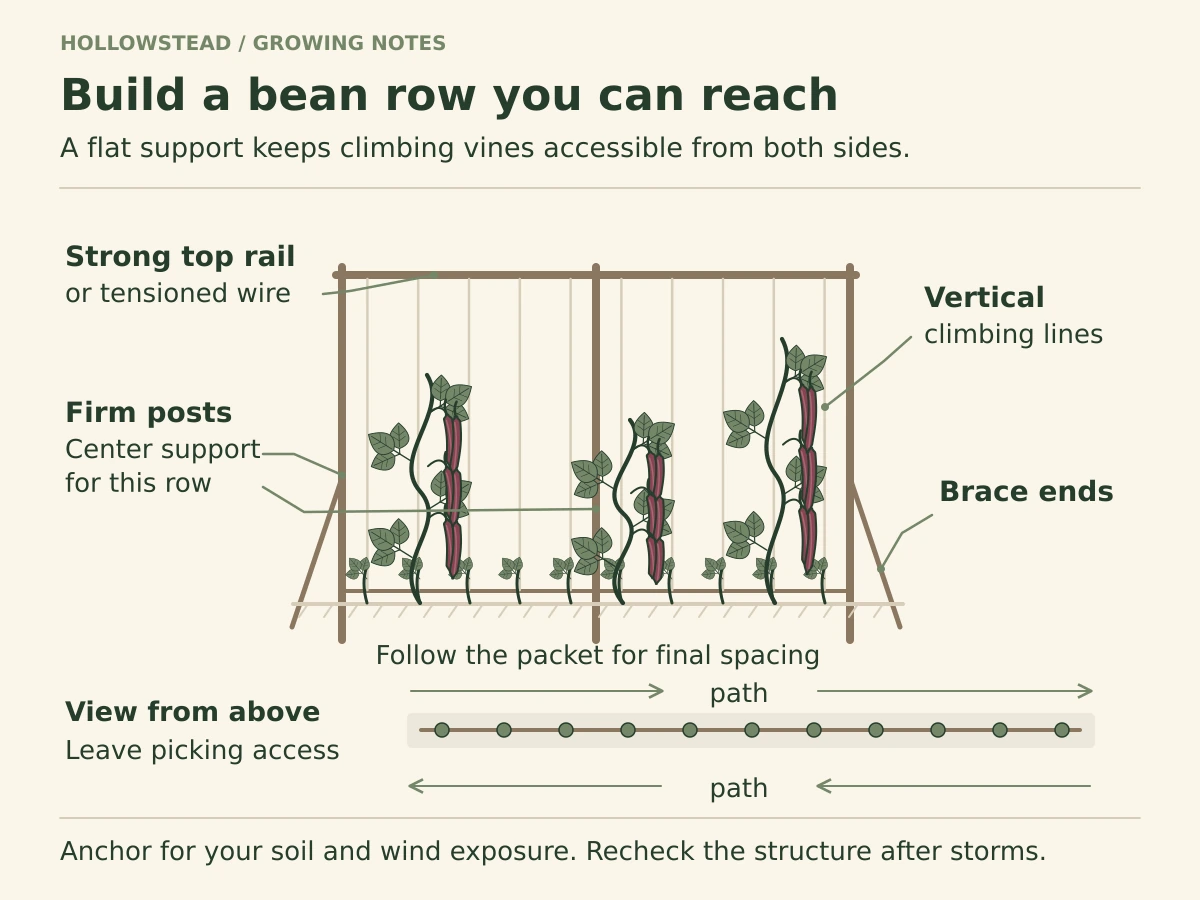 View full-size diagram
Loads, anchoring, and storm resistance
A trellis that feels sturdy when bare can behave very differently in July. Mature foliage adds weight; wet foliage adds more; then wind turns the entire wall into a sail. The most important structural question is therefore not “what string should I use?” but where does the load go?
- Drive or set end posts deeply enough for your soil.
- Brace long row systems so end posts cannot lean inward under tension.
- Use UV-stable material if the trellis will stay outdoors all season.
- Do not anchor a tall trellis only to a lightweight container unless the container itself cannot tip.
- Inspect after storms before vines hide loose ties or leaning posts.
Fix a leaning trellis early. Once vines knit through the structure, resetting a post can tear stems and roots. A five-minute brace in June can prevent a destructive repair in August.
Material choice: what vines actually need
Beans do not need an expensive branded trellis. They need continuous vertical elements they can wrap around and a frame that will not collapse. Jute twine, synthetic netting, wire mesh, cattle panel, bamboo, or wood poles can all work if the material is strong enough for the season and the openings do not trap your hands during harvest.
Very wide horizontal-only wires can frustrate young vines because pole beans naturally twine upward rather than weaving themselves through horizontal strands. Maryland specifically notes that pole beans do not interweave themselves through horizontal wires on their own.[1] Add vertical strings or mesh when using a horizontal frame.
Place the trellis with its shadow in mind
A six- to eight-foot wall of bean foliage casts a real shadow. In a northern-hemisphere garden, putting the tallest trellis toward the north side often keeps it from shading shorter sun-loving crops through much of the day. Site constraints may override that rule, but plan the shadow before sowing rather than discovering it after the vines close the canopy.
How to train bean vines
Pole and yardlong beans twine naturally once they find the support. During the first running stage, gently guide loose vines to the nearest vertical element. Do not tie every stem tightly; constricting ties can cut into expanding vines.
If vines reach the top, redirect them laterally or back into the structure. Avoid repeatedly stripping or pruning large amounts of healthy foliage just to maintain a perfect geometric shape.
Guiding bean shoots, using loose ties, keeping pods off soil and harvesting
- Guide young runners early, use loose soft ties only where needed, and check the support after storms. The worked layout above gives anchoring and spacing decisions.
Spacing beans along a trellis
Maryland recommends roughly 4–8 inches between pole bean plants, depending on the system.[1] Spacing too tightly can create a dense canopy that dries slowly after rain. The right density should cover the trellis while still allowing light, airflow, and hands to reach the pods.
Build for harvest access
The crop is not finished when the vine reaches the top. A successful trellis lets you harvest repeatedly without stepping into the root zone, reaching through a thorny jungle of support material, or missing pods hidden on the back side. Leave a path and enough hand clearance around rigid panels.
Reusable versus disposable support
Choose materials partly by how you want to clean them. Rigid metal panels and solid poles cost more up front but are easy to reuse for years. Fine plastic netting can be frustrating to separate from dead vines and may be better treated as a limited-life material. Natural twine is easy to cut down with the vines but must be replaced.
If you rotate crop families between beds, a freestanding panel or movable A-frame gives more flexibility than permanent posts sunk into one bean row. Permanent structures can still work; just plan what non-bean climber will use them in rotation years.
End-of-season trellis cleanup
After frost or final seed harvest, remove vines rather than leaving a dense mat on reusable supports. Illinois recommends removing bean debris where bacterial blight is a concern.[4] If plants were diseased, dispose of badly infected material appropriately and clean soil and plant residue from reusable clips, strings, or panels before storage.
For twine or biodegradable netting, replacement may be easier than untangling dead vines. For rigid panels and posts, annual cleaning makes next season’s installation much easier and reduces accidental carryover of plant debris.
A CLIMBER FOR THE TRELLIS
Put the structure to work.
Red Noodle is the Hollowstead bean that truly needs this guide; Royal Burgundy stays in a compact bush.
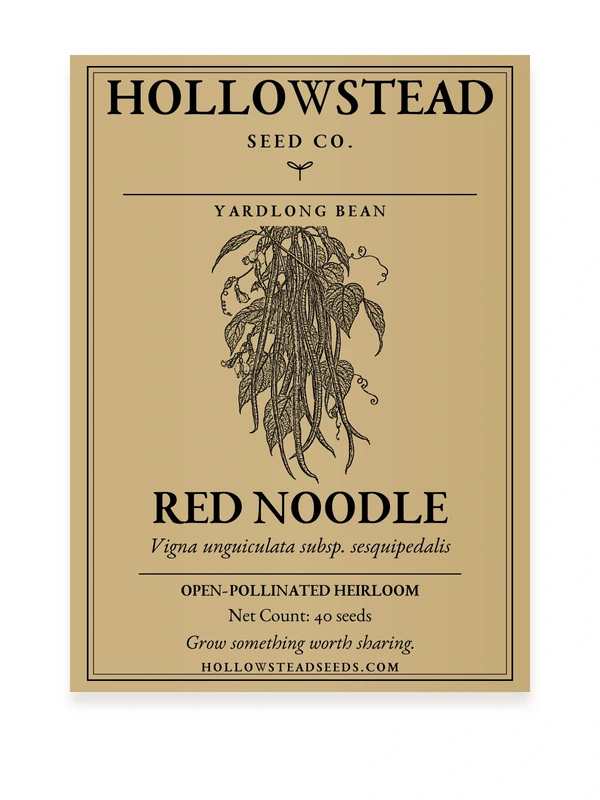
HOLLOWSTEAD SEED
Red Noodle Yard Long Bean Seeds
$4.49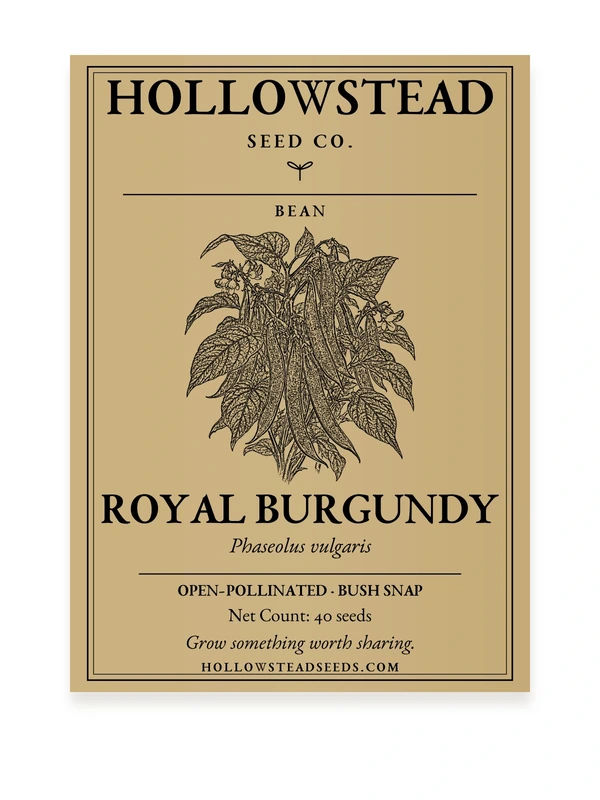
HOLLOWSTEAD SEED
Royal Burgundy Bush Bean Seeds
$4.49KEEP LEARNING
Related Hollowstead guides
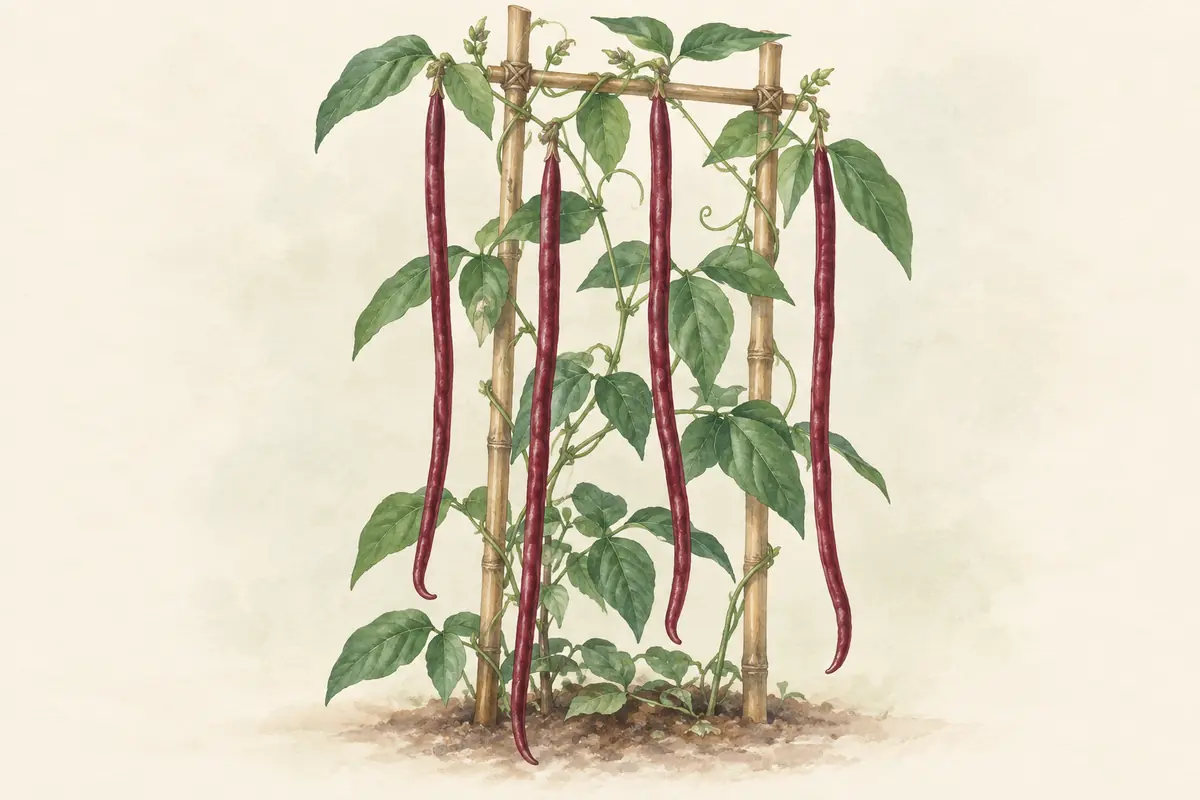
BEAN VARIETY GUIDE
Red Noodle Yard Long Bean Growing Guide
Red Noodle is a heat-loving yardlong bean with vigorous vines and burgundy-red pods. Learn how warm it wants to be, how much trellis to build, when to sow, and how to judge the best harvest stage.
Read the guide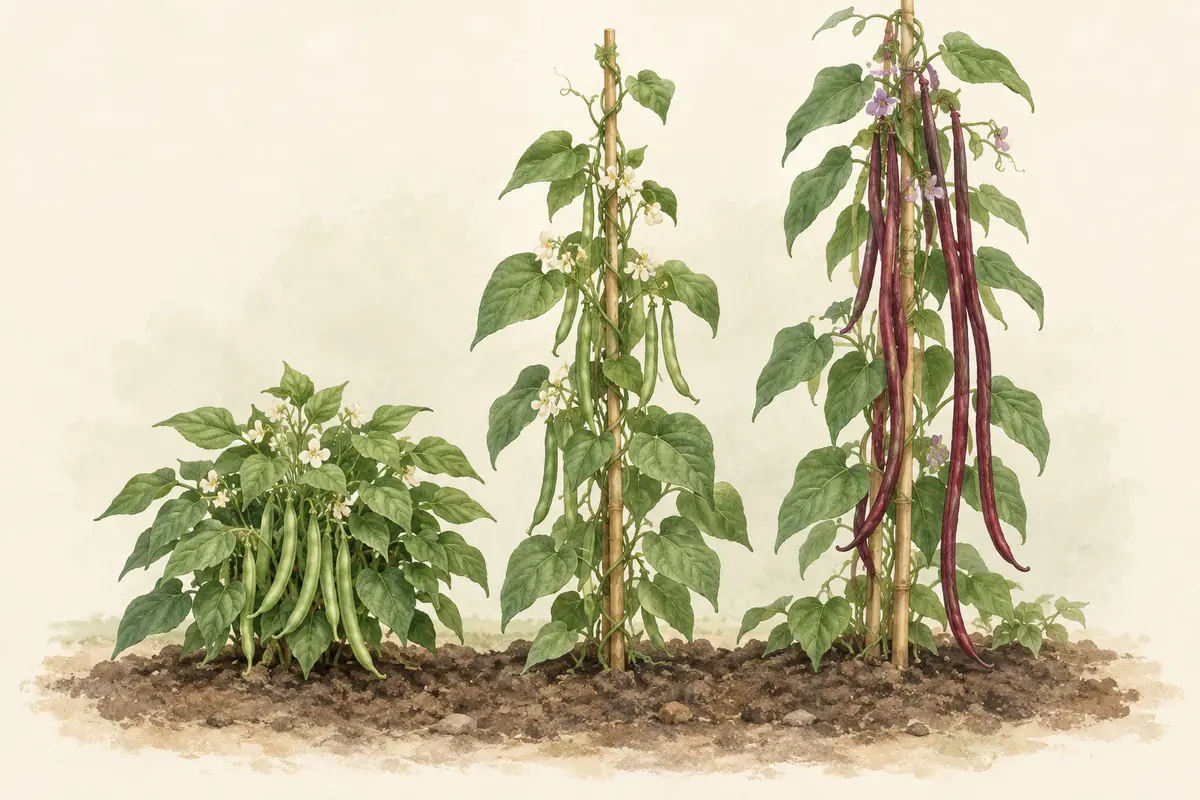
BEAN COMPARISON
Bush Beans vs. Pole Beans vs. Yardlong Beans
Bush, pole, and yardlong beans can all produce tender pods, but they use the garden very differently. Compare support, space, harvest pattern, summer heat preference, and the situations where each growth habit makes sense.
Read the guide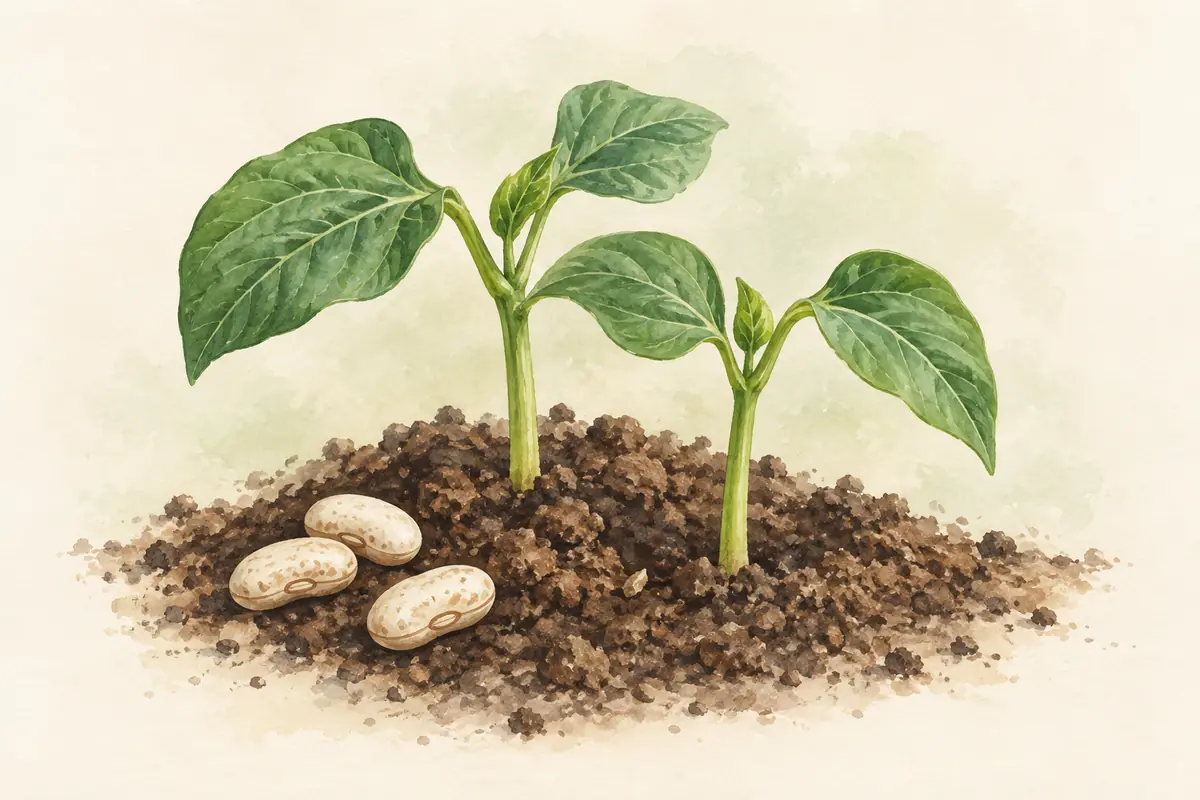
BEAN GROWING
Growing Beans From Seed: The Complete Guide
Grow beans with confidence from direct sowing through harvest. Learn when soil is warm enough, how deeply to sow, when climbing beans need support, how succession planting works, and how to diagnose common early problems.
Read the guideFrequently asked questions
Can beans climb a wooden fence?
They can climb if there are narrow edges, wire, twine, or other features for vines to wrap around. A broad smooth board alone is not an ideal twining surface.
Can I add the trellis after beans sprout?
You can, but it is easier and safer to install supports at planting. That avoids driving posts through developing roots and prevents young vines from tangling before the structure arrives.[1]
How tall should Red Noodle support be?
UF/IFAS describes long-bean vines reaching roughly 9–12 feet. A well-anchored 6–8-foot support can work if vines have room to continue along the top or drape within reach.[3]
Do bush beans benefit from this kind of trellis?
No climbing trellis is needed for a true bush bean such as Royal Burgundy.
Sources & further reading
- University of Maryland Extension Growing Beans in a Home Garden https://www.extension.umd.edu/resource/growing-beans-home-garden
- Clemson Cooperative Extension Bush & Pole-Type Snap Beans https://hgic.clemson.edu/factsheet/bush-pole-type-snap-beans/
- University of Florida IFAS Extension Long Bean—an Asian Vegetable Emerging in Florida https://edis.ifas.ufl.edu/publication/HS1268
- Illinois Extension Snap Beans https://extension.illinois.edu/gardening/snap-beans
Hollowstead Growing Notes
A little help for your next growing season
Practical sowing advice, help choosing seeds, and occasional Hollowstead shop news. Usually one or two emails a month, plus a short welcome note.
Choose your topics and frequency after you confirm. Our guides and planting calendar are always free.