
SEED STARTING
Growing Four Annual Flowers From Seed
Grow annual flowers from seed with a crop-by-crop plan for sowing, germination, thinning, transplanting, soil preparation, watering, pinching, bloom care, cutting, troubleshooting, and seed saving.
FlowersSeed startingBeginner → advanced
Published by Hollowstead Seed Co. · How this guide is prepared
Quick answer
Growing annual flowers from seed is easiest when you stop treating every packet the same. Calendula tolerates cooler conditions, while zinnias, cosmos, and sunflowers are warm-season annuals that are normally planted after frost. Some flowers benefit from an indoor head start; others are so fast and transplant-sensitive that direct sowing is simpler.[1][2]
The useful rule: match sowing method to the crop, build a strong root system before pushing bloom, then manage light, spacing, moisture, support, harvest, and seed saving as one season-long system.
At a glance
| Decision | Best starting point |
|---|---|
| Indoor vs. direct sow | Choose by crop, frost date, and transplant tolerance |
| Seed depth | Follow the packet; tiny seed is usually shallower |
| Light after emergence | Bright light immediately |
| Outdoor site | Full sun for Hollowstead’s four flower crops |
| Soil | Well drained; test before major amendments |
| Water | Deep enough for the root zone, then allow air back in |
| Fertility | Enough for steady growth, not automatic heavy feeding |
| Long bloom | Cut/deadhead productive plants and succession-sow where useful |
- Season
- Know whether the crop prefers cool or warm conditions
- Sun
- 6–8+ hours for these four annuals
- Drainage
- Never build a flower bed around chronic saturation
- Spacing
- Enough air and root room for mature plants
- Harvest
- Cut/deadhead on purpose
- Seed saving
- Reserve selected blooms before you deadhead everything
- Plan from frost datesMap cool-season and warm-season sowing windows before opening packets.
- Sow for the cropDirect sow fast, root-sensitive flowers or start indoors when earlier bloom is worth the work.
- Build sturdy seedlingsAfter emergence, prioritize light, moderate moisture, airflow, and timely thinning.
- Harden and transplantAcclimate indoor seedlings gradually and wait for appropriate outdoor conditions.
- Shape the plantPinch, space, or support only when the crop and your harvest goal benefit.
- Cut and maintainHarvest or deadhead regularly while managing water, weeds, pests, and disease.
- Choose seed parentsLeave selected healthy blooms to mature fully if you want seed for next year.
Choose indoor starting or direct sowing for a reason
This guide compares four annual flower crops in this catalog: California Giant zinnia, Sensation Mixture cosmos, Zeolights calendula, and Lemon Queen sunflower. Their seasons and root handling differ; use the named variety guide for exact sowing detail.
| Crop | Season and start |
|---|---|
| Zeolights calendula | Cool spring or fall; direct sow or transplant |
| California Giant zinnia | Warm after frost; direct sow or careful start |
| Sensation Mixture cosmos | After frost; direct sow or careful start |
| Lemon Queen sunflower | After frost; direct sow or handle roots gently |
Indoor seed starting is a timing tool, not a quality badge. University of Minnesota Extension notes that warm-season cut flowers such as sunflowers, zinnias, and cosmos can be direct sown after frost or started a few weeks early indoors. Direct sowing eliminates transplant shock and is especially convenient for sunflowers, whose roots do not appreciate rough handling.[2]
Indoor starting earns its space when you have a short season, want an earlier first harvest, need to protect a small amount of expensive seed, or want uniform transplants ready to place at final spacing. If the indoor setup has weak light, erratic watering, or crowded trays, direct sowing may produce the stronger plant.
Plan backward from weather, not from impatience. A six-week-old transplant held indoors too long can be harder to establish than a younger plant set out at the right time.
Before committing a planting window to an older packet, use the seed-storage and home germination-test guide. It helps separate an uncertain seed lot from problems in the seedbed.
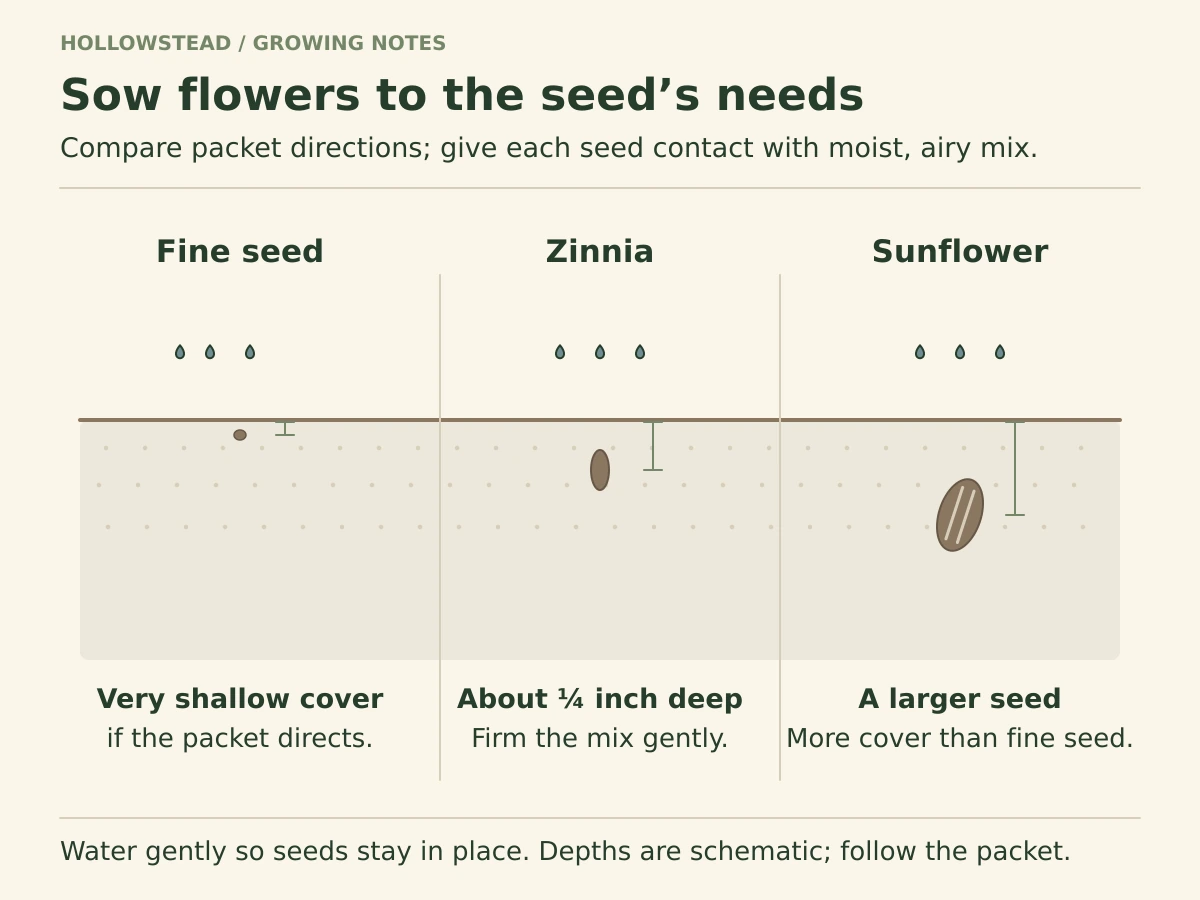
Sowing depth and moisture: seed-to-soil contact without burial
Use the packet’s crop-specific depth first. Seed Savers Exchange gives the broad rule of sowing around twice the seed’s diameter, while emphasizing that very small seeds may belong at or near the surface.[5] Sunflower seed can tolerate more cover than fine flower seed; zinnias are commonly sown around ¼ inch deep.[7]
Moisture should be consistent enough to keep the seed from repeatedly drying during germination but not so saturated that oxygen disappears from the pore spaces. A fine mist, bottom watering, or gentle watering keeps tiny seed in place. Outdoors, a fine, firm seedbed improves contact and makes shallow sowing easier than cloddy soil.[1]
 View full-size diagram
After emergence, light matters more than the humidity dome
Warmth and moisture initiate germination; once the seedling is above the mix, the management goal changes. Remove or vent humidity covers, put seedlings under strong light, and let air move around the tray. Seed Savers recommends bright light and specifically treats humidity covers as a germination aid rather than a permanent seedling environment.[5]
Watch plant form rather than obsessing over one universal temperature. Tall, pale, leaning seedlings are usually asking for more usable light. Soft seedlings that stay constantly wet are asking for a better wet-dry rhythm and more airflow.
Use developmental stages
- Sow at the crop’s depth, keep moisture even and record actual seed-zone temperature.
- General zinnia: 4–8 days at 70–75°F; cosmos: 7–14 days at 70–75°F; calendula: 1–2 weeks near 60°F.
- For sunflower, follow the packet’s emergence window and check for removed seed.
- After emergence, give strong light and airflow; thin and transplant by true leaves and root readiness.
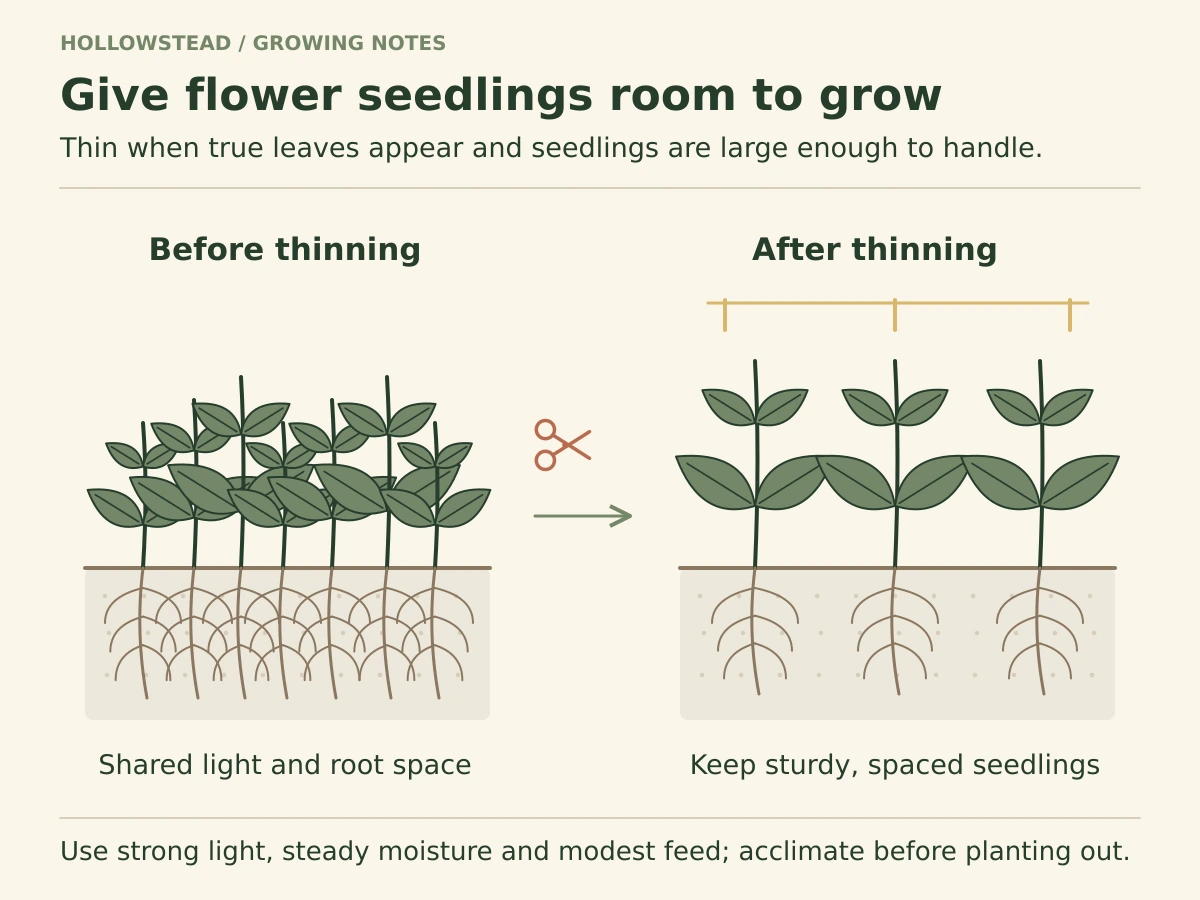
Thin before crowding becomes the problem you are trying to fix
When seedlings have true leaves and are large enough to handle, thin or separate extras so the selected plants can develop a balanced canopy and root system. Maryland Extension recommends thinning direct-sown annuals rather than leaving a dense mat of seedlings to compete.[3]
Indoor-grown flowers also need hardening off. Over roughly a week, move from protected shade and calm conditions toward longer periods of direct sun and normal outdoor wind. Seed Savers advises starting in a sheltered, shaded location before progressively increasing exposure.[5] Hardened plants are not “toughened” by severe wilting; the aim is gradual acclimation without damaging leaves.
 View full-size diagram
Soil testing, site preparation, and fertility
A flower bed cannot be fertilized out of poor light or poor drainage. Missouri Extension recommends testing when soil fertility and acidity are unknown, and preparing a well-drained bed rather than leaving low pockets that stay wet after rain.[1] For these Hollowstead annuals, choose a full-sun site and improve compacted or structure-poor soil with appropriate organic matter rather than burying the bed under fertilizer.
Think of fertility by crop. Cosmos is famous for blooming well in relatively lean ground; Utah State specifically warns that rich soil can produce weak stems and sparse, late flowering.[8] Calendula is more comfortable with moderate fertility, while tall sunflowers and heavily harvested zinnias still need a functioning root zone and adequate nutrients. A soil test helps separate a true nutrient need from a habit of adding more.
More nitrogen is not the universal answer to fewer flowers. Excess nitrogen can favor vegetative growth, and Missouri Extension specifically cautions that overfeeding non-blooming annuals can delay flowering.[1]
Pinching, support, and plant shape
Pinching removes the growing tip so buds below it can become branches. That can be useful on zinnias and cosmos grown for repeated cutting, but it is not a ritual every flower needs. If you want a single tall central stem, do not pinch simply because a chart says “pinch.” If you want many manageable cutting stems, pinching a young, vigorously growing plant can make sense.
Support is similarly goal-specific. Tall cosmos and branching sunflowers can lodge in storms; tall zinnias can lean once they carry many blooms. Seed Savers’ current flower profiles recommend support for cosmos, sunflower, and zinnia where their height and exposure justify it.[6] Install corralling twine, stakes, or horizontal support before a storm turns support into repair.
Water the root zone, then let oxygen return
Maryland Extension recommends moistening the entire root zone without keeping the bed soggy and favors soaker or drip irrigation where practical because it reduces wet foliage.[3] Missouri similarly prefers thorough watering over frequent light sprinkles and notes that wet foliage and crowding increase disease pressure.[1]
Mulch can slow evaporation and suppress weeds once the soil has warmed for tender crops. Keep it from smothering small direct-sown seedlings. During sustained cutting, watch the plants: pale growth, reduced vigor, or a confirmed soil-test need may justify feeding, but a healthy, dark-green cosmos patch is not improved by routine nitrogen.
From buds to cut flowers: harvest changes the plant
Flower harvest is not merely the end product; it is part of crop management. Repeatedly cutting zinnias, cosmos, and calendula removes developing seed structures and can keep plants producing. Branching sunflower behaves differently: each plant has a finite framework of branches and buds, so stem selection matters.
Harvest stage also differs. Seed Savers’ 2025–26 flower profiles recommend cosmos when buds are partially open, sunflower as florets begin to rise, zinnias when the stem below the head is stiff, and calendula as buds begin opening.[6] That earlier calendula cue is a trial alternative to the roughly halfway-open starting cue in the bouquet guide, which also explains postharvest handling.
Flower pests, disease, and prevention
Good prevention is mostly unglamorous: clean starting media, healthy seed/transplants, appropriate spacing, drainage, irrigation that does not repeatedly soak foliage, sanitation, and early observation. Missouri Extension notes that crowded plantings stay wet longer and generally face more disease pressure.[1] Zinnias are particularly worth spacing and watering thoughtfully because leaf diseases and powdery mildew can build late in humid seasons.[7]
Do not spray first and diagnose second. Identify whether the damage is chewing, sucking, spotting, mildew, wilt, or a root-zone problem. Remove badly diseased material when appropriate, avoid working wet foliage, and clean tools between obviously diseased plants.
In-season flower troubleshooting
Use the pattern of symptoms to narrow the problem before changing water, fertilizer, and pesticides at the same time.
Saving flower seed with intention
Seed saving begins before the first mature seed appears. Decide which healthy, true-to-type plants you want to reproduce and stop cutting selected blooms. Allow seed heads to mature fully and dry, then harvest on a dry day and finish drying before storage.[5]
Open-pollinated does not mean “cannot cross.” Sunflowers, cosmos, calendula, and zinnias all can cross with compatible varieties through insect pollination; Seed Savers publishes isolation guidance ranging from hundreds of feet to fractions of a mile depending on crop.[6] A home gardener who is saving seed simply for fun can accept crossing. If maintaining a named variety matters, use appropriate isolation, grow one variety of that species, or use controlled pollination/bagging.
Label saved seed with variety, year, and any notes about the parent plants. Store fully dry seed cool, dark, and dry. The advanced skill is not cleaning every bit of chaff—it is knowing what you selected and whether pollen from another compatible variety could have reached it.
Choose your variety’s next step
Use Lemon Queen Sunflower, Sensation Mixture Cosmos, California Giant Mix Zinnia, Zeolights Calendula for exact catalog baselines, seedling checks, containers and home seed saving.
Choose container sizes, follow the crop-specific cutting stages, and decide which heads to deadhead or keep for seed.
Seedling milestones vary by flower
Treat sowing, emergence, true leaves and transplant readiness as stages, not a shared two-week deadline. General zinnia guidance gives about 4–8 days at 70–75°F (21–24°C), cosmos about 7–14 days at that temperature, and calendula about 1–2 weeks near 60°F (16°C). These benchmarks are sourced in the linked variety guides. For sunflower, use the seed packet’s emergence window and watch the seedbed for removed seed as well as temperature and moisture problems. Once seedlings emerge, provide strong light, remove humidity covers and thin before crowding.
GROW THESE FLOWERS
Put the guide to work.
Use the crop-specific guides for Lemon Queen sunflower, Sensation cosmos, California Giant zinnia, and Zeolights calendula once the general seed-to-bloom system is clear.
HOLLOWSTEAD SEED
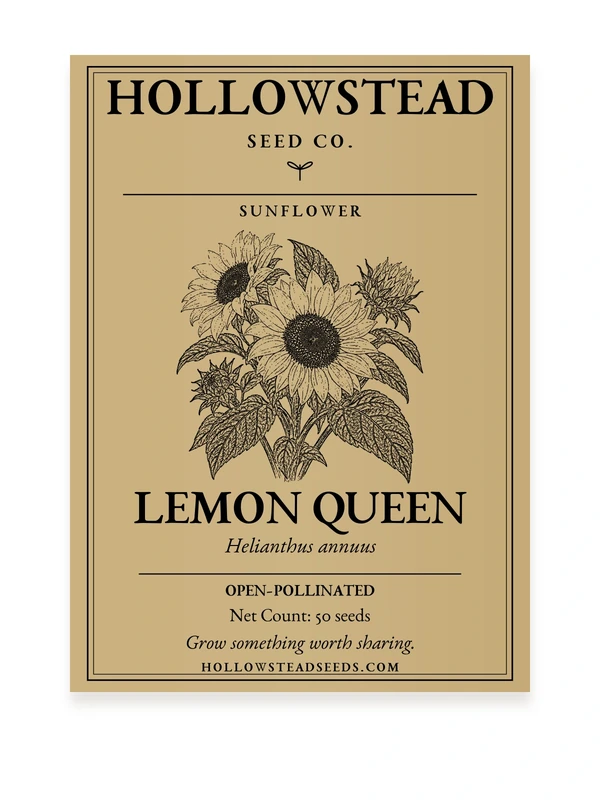
Lemon Queen Sunflower Seeds
$3.99
HOLLOWSTEAD SEED
Sensation Mixture Cosmos Seeds
$3.99
HOLLOWSTEAD SEED
California Giant Mix Zinnia Seeds
$3.99
HOLLOWSTEAD SEED
Zeolights Calendula Seeds
$3.99KEEP LEARNING
Related Hollowstead guides
SUNFLOWER GUIDE
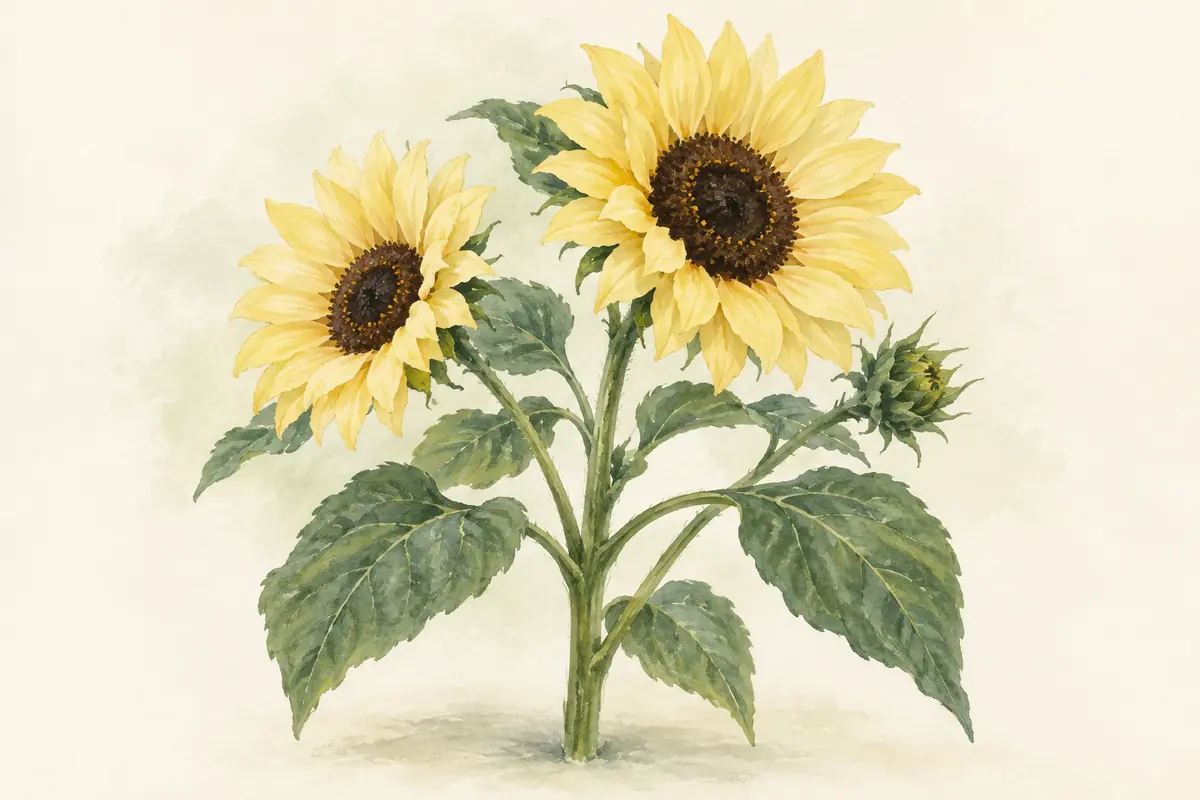
Lemon Queen Sunflower Growing Guide
Grow Lemon Queen sunflower as a tall, branching annual for pale-yellow blooms, cut stems, pollinator value, succession sowings, mature seed heads, and intentional seed saving.
Read the guide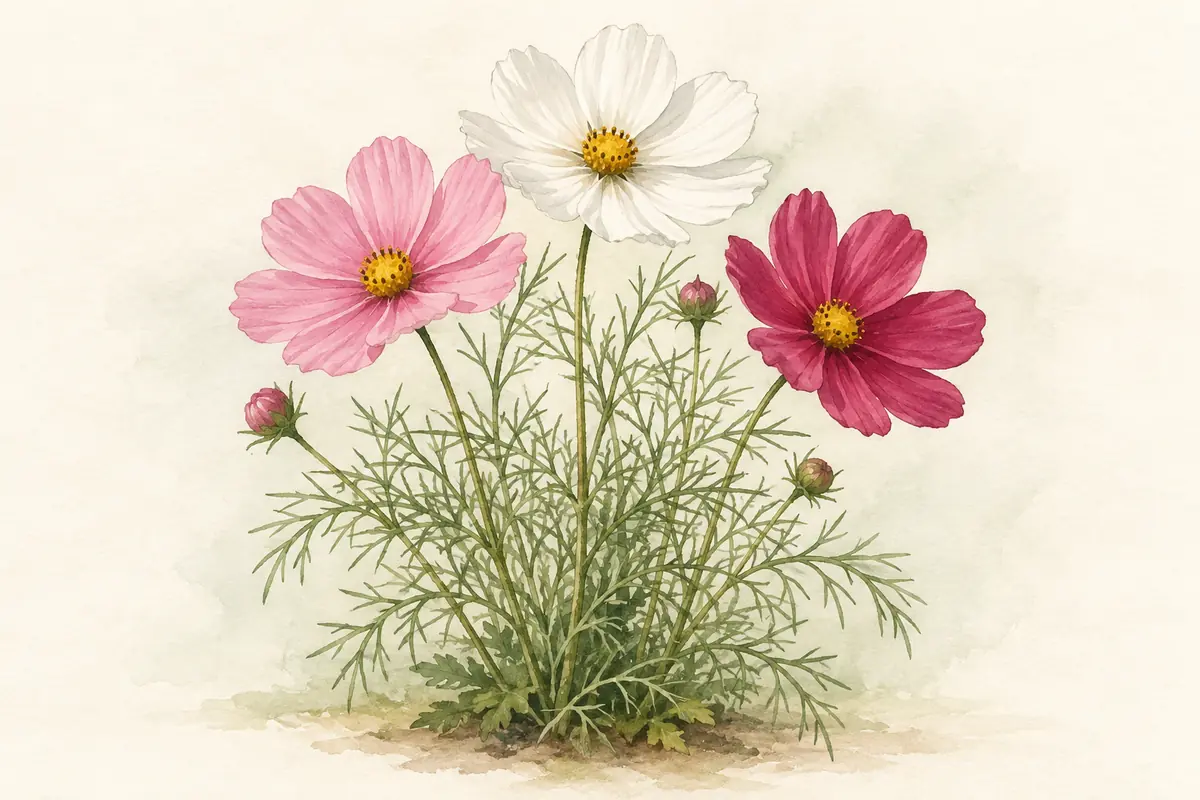
COSMOS GUIDE
Sensation Mixture Cosmos Growing Guide
Grow Sensation cosmos for tall, airy summer color and cut flowers with direct sowing, modest fertility, pinching, support, repeated harvest, deadheading, and seed saving.
Read the guide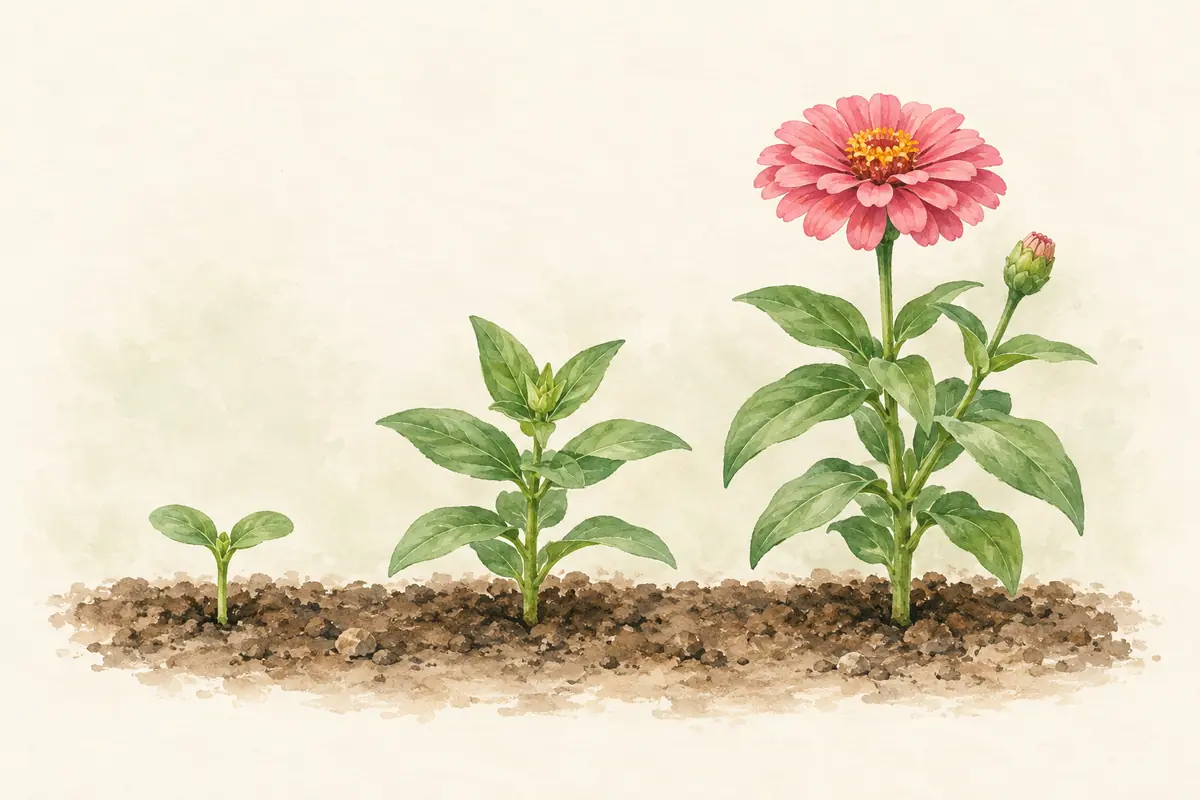
GARDEN PLANNING
Succession Planting Flowers for Continuous Blooms
Build continuous flower harvests with repeat sowings, overlapping generations, crop-specific intervals, frost-date planning, bed resets, and records for sunflowers, zinnias, cosmos, and calendula.
Read the guideFrequently asked questions
Do all annual flowers need to be started indoors?
No. Many are excellent direct-sown crops. Indoor starting is useful when it improves timing or stand establishment, not because it is automatically superior.
How do I know whether a flower needs fertilizer?
Start with soil testing and plant appearance. Correct obvious deficiencies, but do not assume that more fertilizer creates more flowers.
Should I pinch every flower seedling?
No. Pinch when branching supports your crop and harvest goal. Do not pinch plants you want to grow as a single main stem.
Can I save seed from open-pollinated flowers?
Yes, but maintaining a named variety requires attention to cross-pollination, selection, seed maturity, drying, and storage.
Why do flowers look healthy but stop blooming?
Check maturity, temperature, seed set, light, water, crowding, and fertility before reaching for a product. The poor-bloom guide walks through that diagnosis in order.
Sources & further reading
- University of Missouri Extension Flowering Annuals: Characteristics and Culture https://extension.missouri.edu/publications/g6629
- University of Minnesota Extension Where bouquets begin: growing a cutting garden from seed https://extension.umn.edu/news/where-bouquets-begin-growing-cutting-garden-seed
- University of Maryland Extension Care of Annuals and Perennials https://extension.umd.edu/resource/care-annuals-and-perennials
- Illinois Extension Caring for Annuals https://extension.illinois.edu/flowers/caring-annuals
- Seed Savers Exchange Growing and Saving Flower Seeds https://seedsavers.org/learn/growing-guides/growing-and-saving-flower-seeds/
- Seed Savers Exchange Flower Seed Saving Profiles https://seedsavers.org/flower-seed-saving-profiles/
- University of Minnesota Extension Zinnia https://extension.umn.edu/garden-and-home/yard-and-garden/gardening-in-minnesota/zinnia
- Utah State University Extension — Cosmos in the Garden
Hollowstead Growing Notes
A little help for your next growing season
Practical sowing advice, help choosing seeds, and occasional Hollowstead shop news. Usually one or two emails a month, plus a short welcome note.
Choose your topics and frequency after you confirm. Our guides and planting calendar are always free.