
HARVEST GUIDE
When and How to Harvest Beans
Bean harvest quality depends more on pod stage than the date on a packet. Learn the cues for tender snap beans and yardlong beans, how often to pick, how to avoid breaking stems, and when a pod has moved toward shell or dry-bean maturity.
BeansHarvest guideBeginner → advanced
Published by Hollowstead Seed Co. · How this guide is prepared
Quick answer
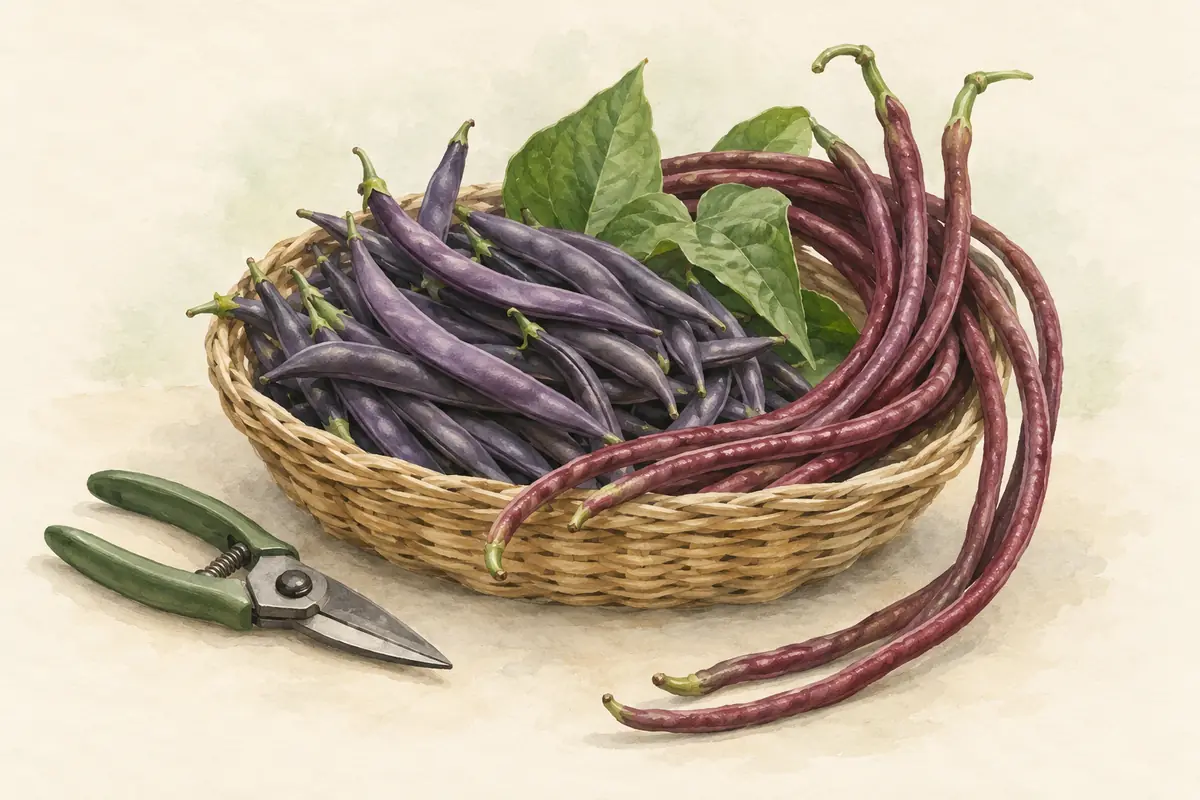
For snap beans, harvest when pods are firm, crisp, fully elongated, and still relatively smooth—before the seeds inside develop obvious bulges. Yardlong beans are also harvested immature, while shell beans and dry beans are intentionally allowed to move farther toward seed maturity.[1][2]
Pick after foliage is dry. Illinois warns that handling wet bean plants can spread bacterial blight, and brittle stems are easier to damage when you pull hard on pods.[1]
Harvest at a glance
| Snap bean | Full length, crisp pod, seeds still small |
|---|---|
| Yardlong | Long, flexible, tender, before strong seed swelling |
| Shell bean | Seeds plump; pod tough but not fully dry |
| Dry bean | Pod dry; seed hard |
| Seed saving | Healthy plant + fully mature, thoroughly dry seed |
- Snap cue
- Pod quality, not packet date
- Pick dry
- Wait for dew/rain to dry
- Frequency
- More often at peak production
- Seed bulge
- Signals declining snap quality
- Seed crop
- Let selected pods dry fully
Harvest stage by bean use
When to harvest snap beans
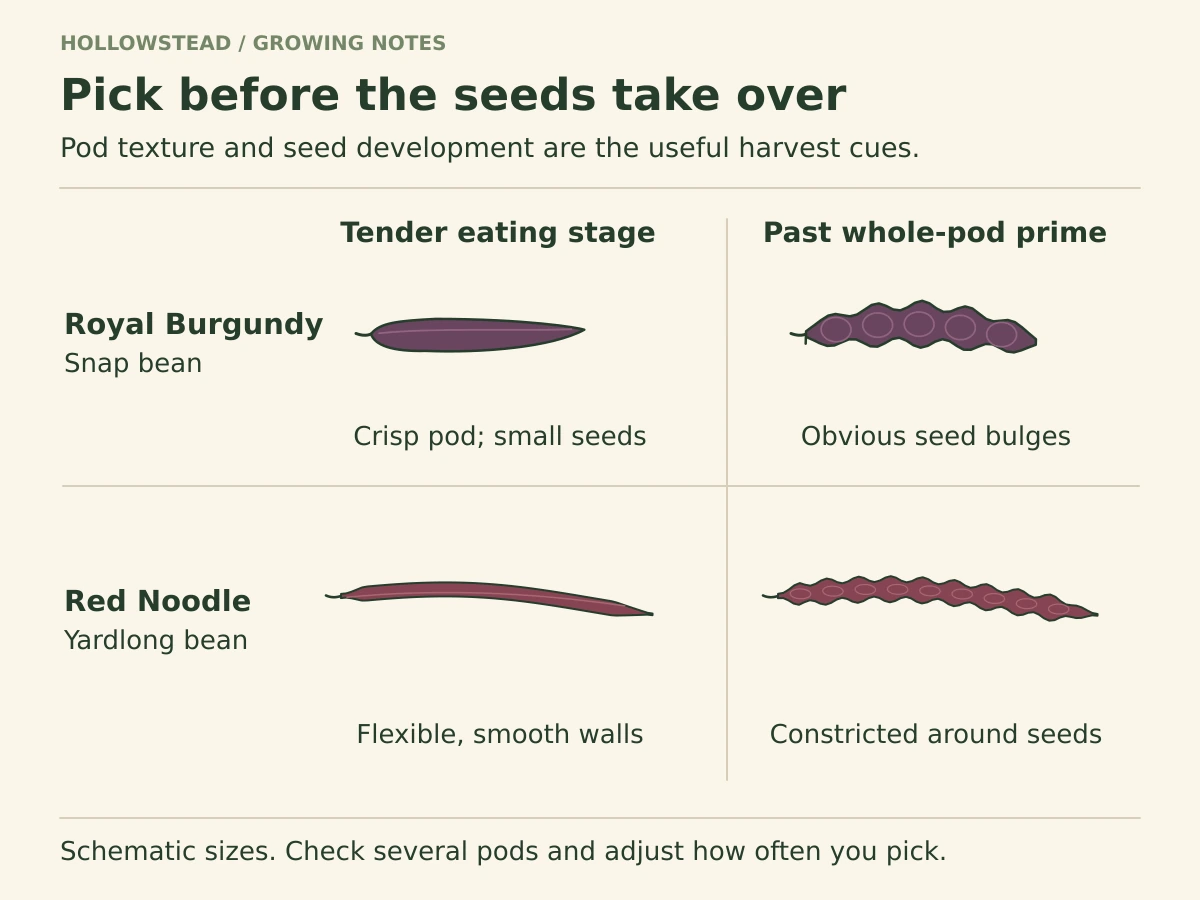
Illinois recommends harvesting when pods are firm, crisp, and fully elongated but before seeds have developed significantly.[1] Minnesota gives the same practical cue: pick snap beans before individual seeds bulge inside the pod.[2]
Use the packet’s days to maturity to know when to start looking, not as a harvest appointment. Temperature, water, crop load, and planting date all move the real harvest window.
 View full-size diagram
When to harvest yardlong beans
Yardlong beans are eaten immature. UF/IFAS describes frequent harvest before seeds mature, and Mississippi State recommends asparagus beans in roughly the 10–18-inch range for snap use.[5][6] Cultivar differences matter: a Red Noodle pod can be longer than a green yardlong cultivar and still be tender.
Look for flexibility, smooth pod walls, and small seeds. Once the pod tightens around large seeds, eating quality is moving toward shell/dry use.
How often should you pick beans?
During peak production, check snap beans every day or two. Regular harvest keeps pods from slipping past prime and reduces the number of mature pods signaling that the plant has successfully completed seed production. Illinois notes that plants continue forming flowers and beans when pods are continually removed before seed maturity.[1]
UF/IFAS describes daily harvest for commercial long-bean production.[5] Home gardeners may not need a literal daily schedule, but yardlong pods can change quickly in hot weather.
How to pick without damaging the plant
Support the stem or cluster with one hand and snap/cut the pod with the other. Illinois warns that bean stems and branches can be brittle.[1] Do not yank a pod downward if the whole branch moves with it.
 View full-size diagram
Why avoid harvesting from wet bean plants?
Illinois specifically advises waiting until dew is off and foliage is dry because working wet beans can spread bacterial blight.[1] This is an easy cultural practice with almost no downside: harvest later in the morning after dew dries, or after rain has passed and foliage has dried.
The same pod can be three different crops
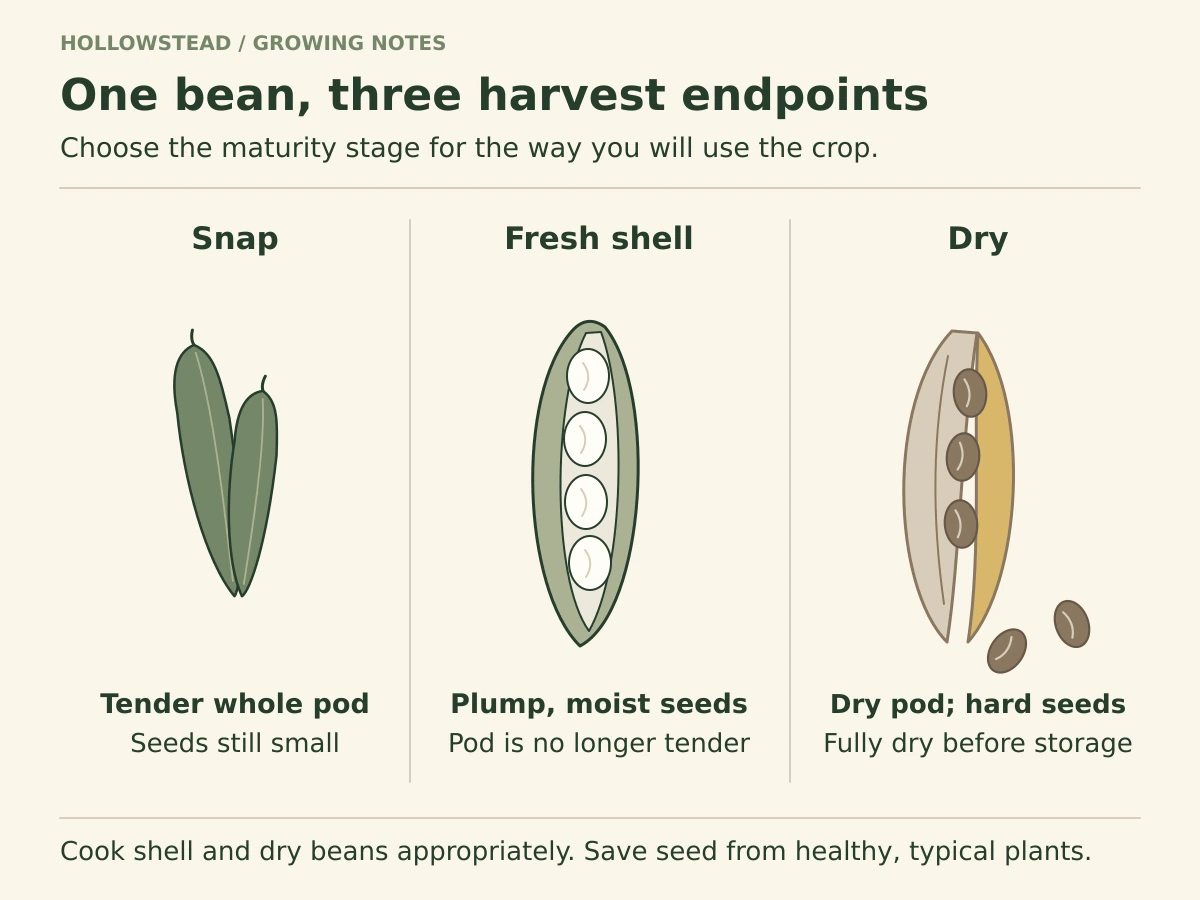
Many common-bean varieties can be harvested as snap beans, allowed to progress to a green-shell stage, or left all the way to dry seed. Those are not three separate species—they are three maturity targets. Understanding that continuum helps rescue an overlooked row: a pod that is too tough for snap use may still contain useful shell beans, and a fully mature pod may become dry beans or seed.
Do not automatically use every overmature snap pod as seed. Seed saving adds another criterion: the parent plant should be healthy and true to type, not simply old enough.
Post-harvest handling and storage
Keep harvested snap beans cool and avoid washing until you are ready to use them if longer storage is the goal. Washington State University notes that unwashed fresh beans can keep up to about a week under refrigeration, while Purdue recommends refrigerated short-term storage and using fresh beans within several days.[7][8]
Quality starts in the garden. Refrigeration cannot turn an overmature, stringy pod back into a tender snap bean. Sort out damaged or diseased pods rather than storing them against sound beans.
Handle field heat quickly
Fresh snap beans continue losing water after harvest. Move them out of direct sun promptly, especially if you pick in summer heat. Cooling preserves crispness better than leaving a basket on the porch while you finish garden chores.
For freezing or canning snap beans, harvest at eating maturity first and use a tested method such as the National Center for Home Food Preservation’s snap-bean freezing instructions or pressure-canning instructions. Follow the chosen method’s bean type, preparation, processing time, and equipment requirements. “Older and tougher” is not a requirement for preservation; preserving a high-quality pod gives a higher-quality finished product.
Shell and dry beans are a different eating stage from tender snap pods; prepare and cook their mature seeds appropriately before eating rather than treating them as raw snap beans.
Saving beans for seed instead of eating
Seed maturity is much later than snap maturity. Seed Savers recommends leaving common-bean pods until they fade and dry, ideally becoming brittle around hard seed.[3] For common beans, save from healthy plants that match the variety. If a plant is unusually diseased, weak, or off-type, do not choose it simply because its pods happened to be left behind.
Common beans are primarily self-pollinating, but crossing can occur. Seed Savers recommends 10–20 feet between common-bean varieties for ordinary home saving, with greater distance for higher genetic purity.[3]
Separate eating rows from seed pods mentally—or physically. The easiest way to lose your seed crop is to pick every beautiful pod at snap stage.
HARVEST TWO VERY DIFFERENT BEANS
Put the harvest cues to work.
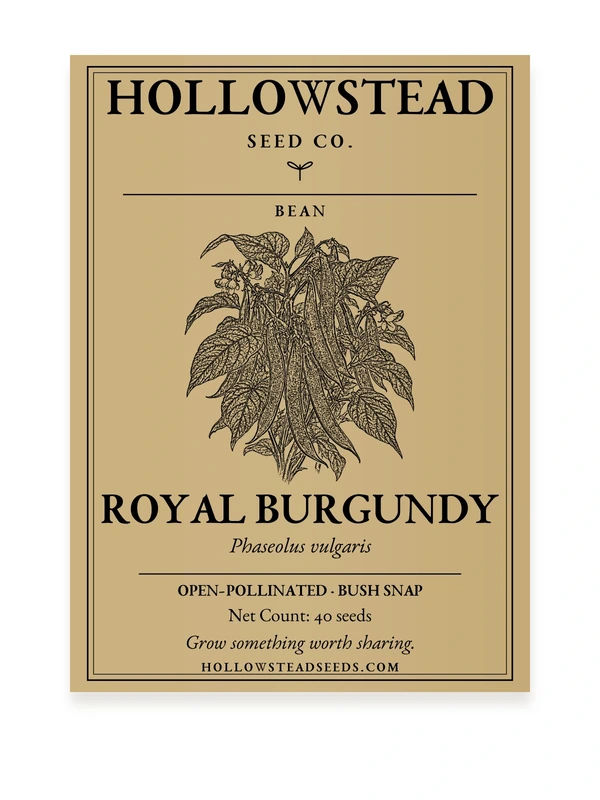
Royal Burgundy gives you a classic snap-bean pod; Red Noodle gives you a long yardlong pod with a different ideal picking cue.
HOLLOWSTEAD SEED
Royal Burgundy Bush Bean Seeds
$4.49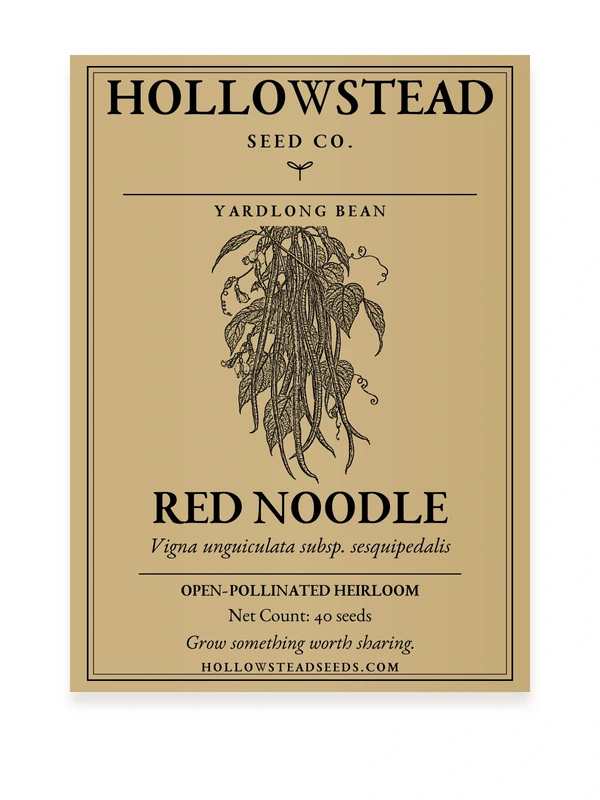
HOLLOWSTEAD SEED
Red Noodle Yard Long Bean Seeds
$4.49KEEP LEARNING
Related Hollowstead guides
BEAN VARIETY GUIDE
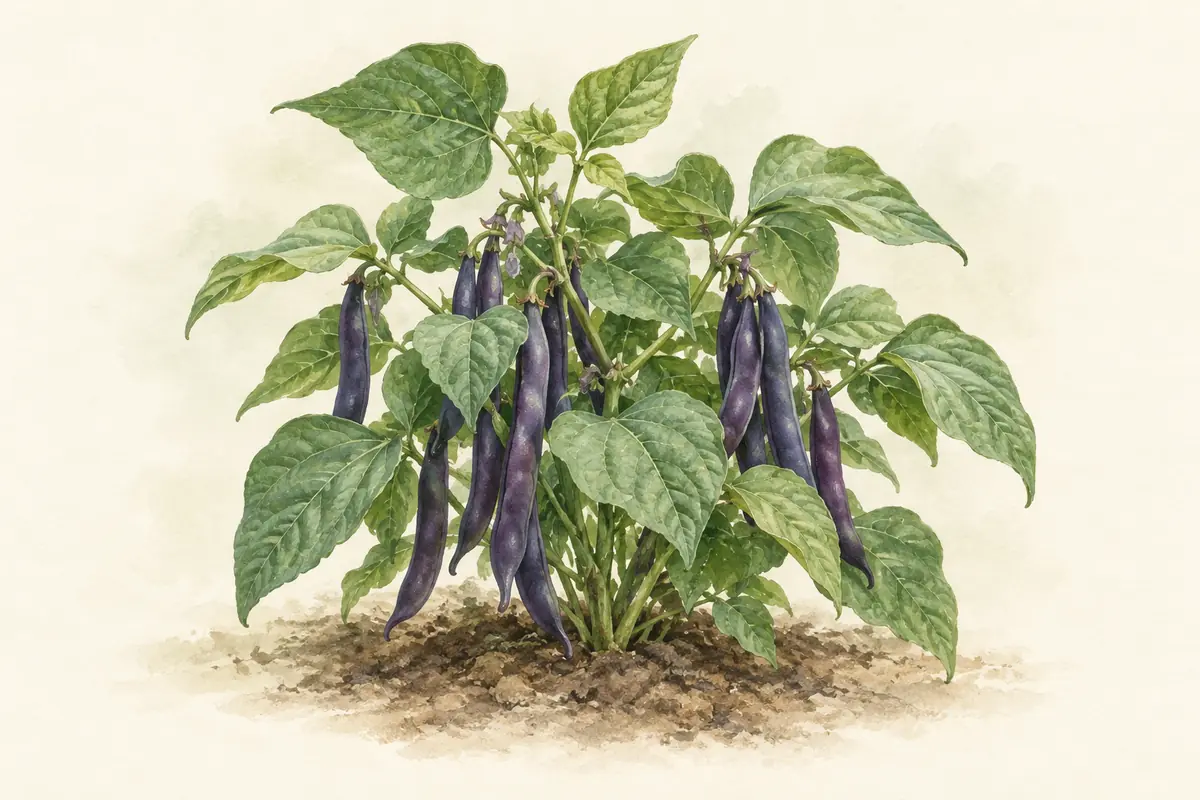
Royal Burgundy Bush Bean Growing Guide
Royal Burgundy is a compact purple-podded snap bean that needs no climbing trellis. Learn when to sow it, how the bush habit changes garden planning, when to harvest, and why the pods turn green when cooked.
Read the guide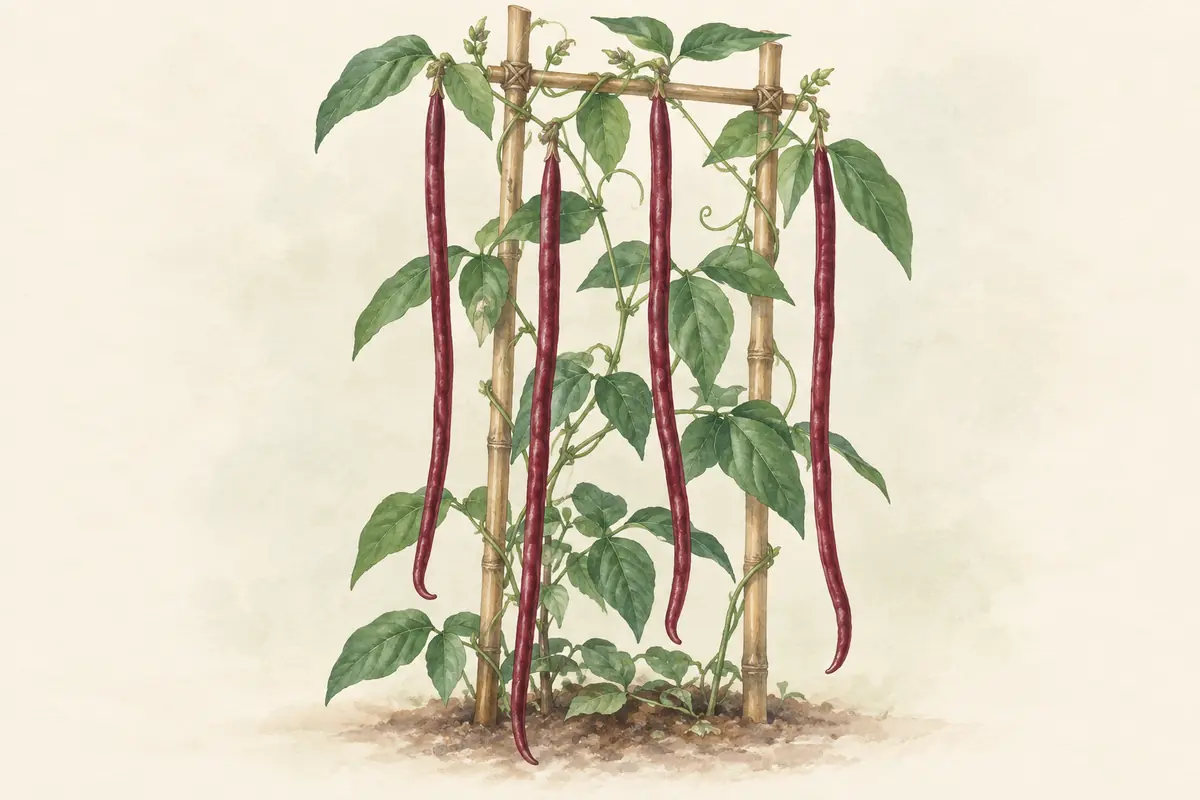
BEAN VARIETY GUIDE
Red Noodle Yard Long Bean Growing Guide
Red Noodle is a heat-loving yardlong bean with vigorous vines and burgundy-red pods. Learn how warm it wants to be, how much trellis to build, when to sow, and how to judge the best harvest stage.
Read the guide
BEAN GROWING
Growing Beans From Seed: The Complete Guide
Grow beans with confidence from direct sowing through harvest. Learn when soil is warm enough, how deeply to sow, when climbing beans need support, how succession planting works, and how to diagnose common early problems.
Read the guideFrequently asked questions
Should I wait for bean seeds to show through the pod?
Not for tender snap beans. Obvious seed bulges are a sign the pod is moving past the best snap stage.[1]
How long should Red Noodle beans be before picking?
There is no single required length. Pick when pods are long and tender, before seeds enlarge enough to make the pod constricted.
Does picking more often really help production?
For snap beans, yes: regularly removing immature pods prevents every pod from being carried to seed maturity and is standard guidance for extending production.[4]
Can I harvest beans while leaves are wet?
It is better to wait for foliage to dry when possible because handling wet plants can spread bacterial disease.[4]
Sources & further reading
- Illinois Extension Snap Beans https://extension.illinois.edu/gardening/snap-beans
- University of Minnesota Extension Growing beans in home gardens https://extension.umn.edu/garden-and-home/yard-and-garden/gardening-in-minnesota/growing-beans
- Seed Savers Exchange Growing Guide: Beans https://seedsavers.org/grow-bean/
- Iowa State University Extension and Outreach All About Beans https://yardandgarden.extension.iastate.edu/how-to/all-about-beans
- University of Florida IFAS Extension Long Bean—an Asian Vegetable Emerging in Florida https://edis.ifas.ufl.edu/publication/HS1268
- Mississippi State University Extension Beans https://extension.msstate.edu/lawn-and-garden/vegetable-gardens/beans
- Washington State University Extension Green Beans https://extension.wsu.edu/skagit/2025/07/25/skagit-food-preservation-green-beans/
- Purdue Extension FoodLink Snap bean https://extension.purdue.edu/foodlink/food.php?food=snap+bean
Hollowstead Growing Notes
A little help for your next growing season
Practical sowing advice, help choosing seeds, and occasional Hollowstead shop news. Usually one or two emails a month, plus a short welcome note.
Choose your topics and frequency after you confirm. Our guides and planting calendar are always free.