
CUCUMBER COMPARISON
Lemon vs. Marketmore 76 vs. National Pickling Cucumbers
Choose among Hollowstead’s three cucumbers by fruit shape, kitchen use and harvest routine. Compare Lemon, Marketmore 76 and National Pickling without overlooking their shared vine, water and pollination needs.
CucumbersComparison guideBeginner → advanced
Published by Hollowstead Seed Co. · How this guide is prepared
Quick answer
Choose Lemon for round pale-yellow salad fruit, Marketmore 76 for long green slices, and National Pickling for regular harvests of smaller pickling fruit. All three are vining garden cucumbers that need warmth, sun, room, steady moisture and pollination. Fruit shape changes the harvest task much more than it changes the basic growing method.
If you have room for one plant, start with what you most often eat and how often you can pick. If you have room for two, choose complementary kitchen roles. Growing all three together is fine for eating; saving seed true to each variety requires a separate pollination plan.
At a glance
| Planning point | Useful starting point |
|---|---|
| Lemon | Round fruit; pick firm and pale to light yellow |
| Marketmore 76 | Long green slicer; start checking around 8–9 inches |
| National Pickling | Shorter fruit; pick to the size required by the recipe |
| Shared habit | Vines; support useful for access |
| Shared season | Plant after frost in warm soil |
| Shared care | Full sun, steady root-zone moisture, pollinator access |
| Seed-saving distinction | All three are Cucumis sativus and can cross |
Compare the fruit
 View full-size diagram
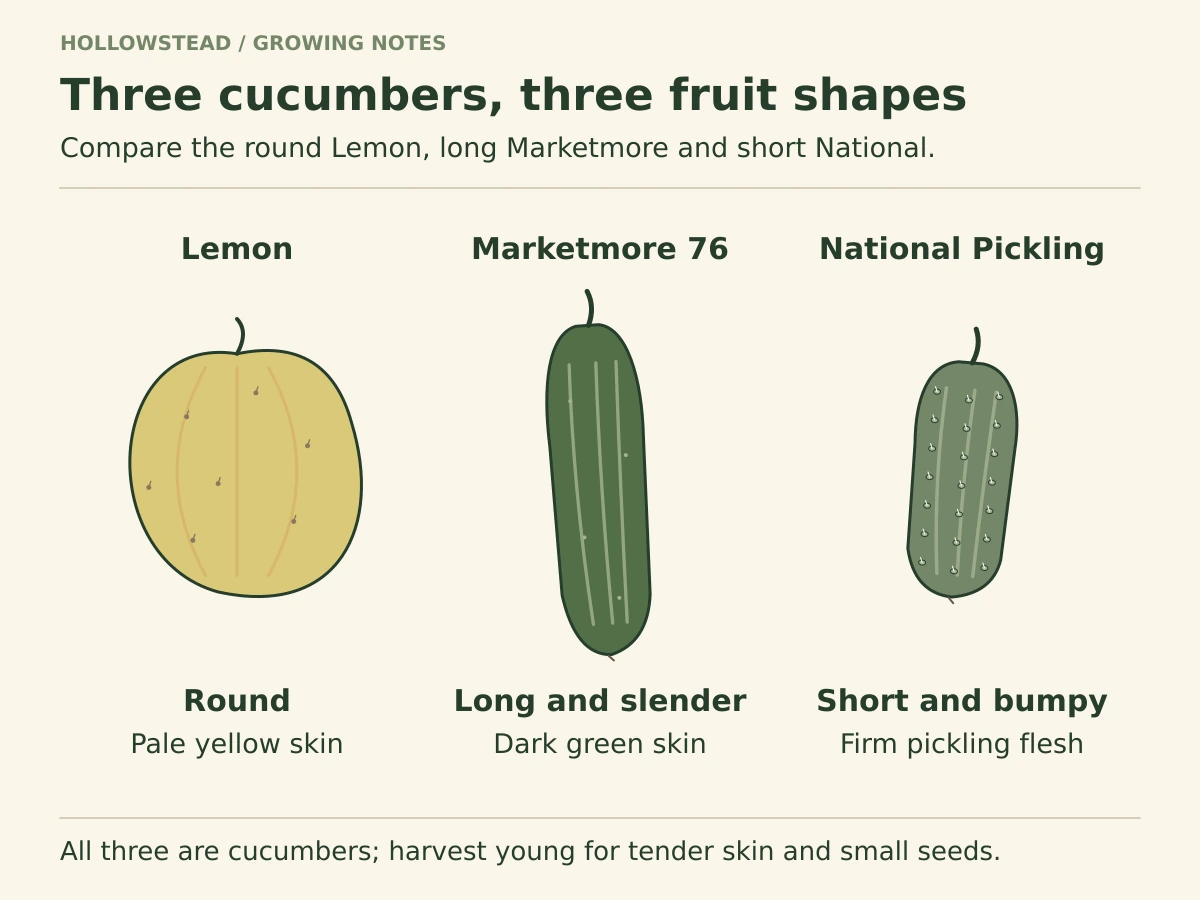
| Variety | Useful kitchen role | Eating-stage cue | What waiting too long changes |
|---|---|---|---|
| Lemon | Round slices, salads and a different-looking fresh cucumber | Firm fruit turning pale to light lemon yellow | Deeper color, a larger seed cavity and coarser texture |
| Marketmore 76 | Familiar long slices for salads and sandwiches | Firm, dark-green fruit near 8–9 inches | Swollen fruit, prominent seeds and eventual yellowing |
| National Pickling | Small pickles, dill-size fruit and fresh use | Firm green fruit at the intended recipe size | Fruit may no longer fit the recipe’s size or texture requirements |
Cornell’s Lemon record describes a round, yellow-fruited vining cucumber.[1] Its Marketmore 76 record describes an open-pollinated vining slicer with slender, dark-green fruit around 8–9 inches long.[2] The table translates those fruit forms into practical harvest decisions; it is not a taste ranking.
With any variety, sample your own crop. Cut one fruit from the stage you intend to pick and look at its seed cavity, skin and texture. A sample gives you a useful reference for the next harvest without pretending that one catalog word can describe every garden.
Match the variety to your garden
 View full-size diagram
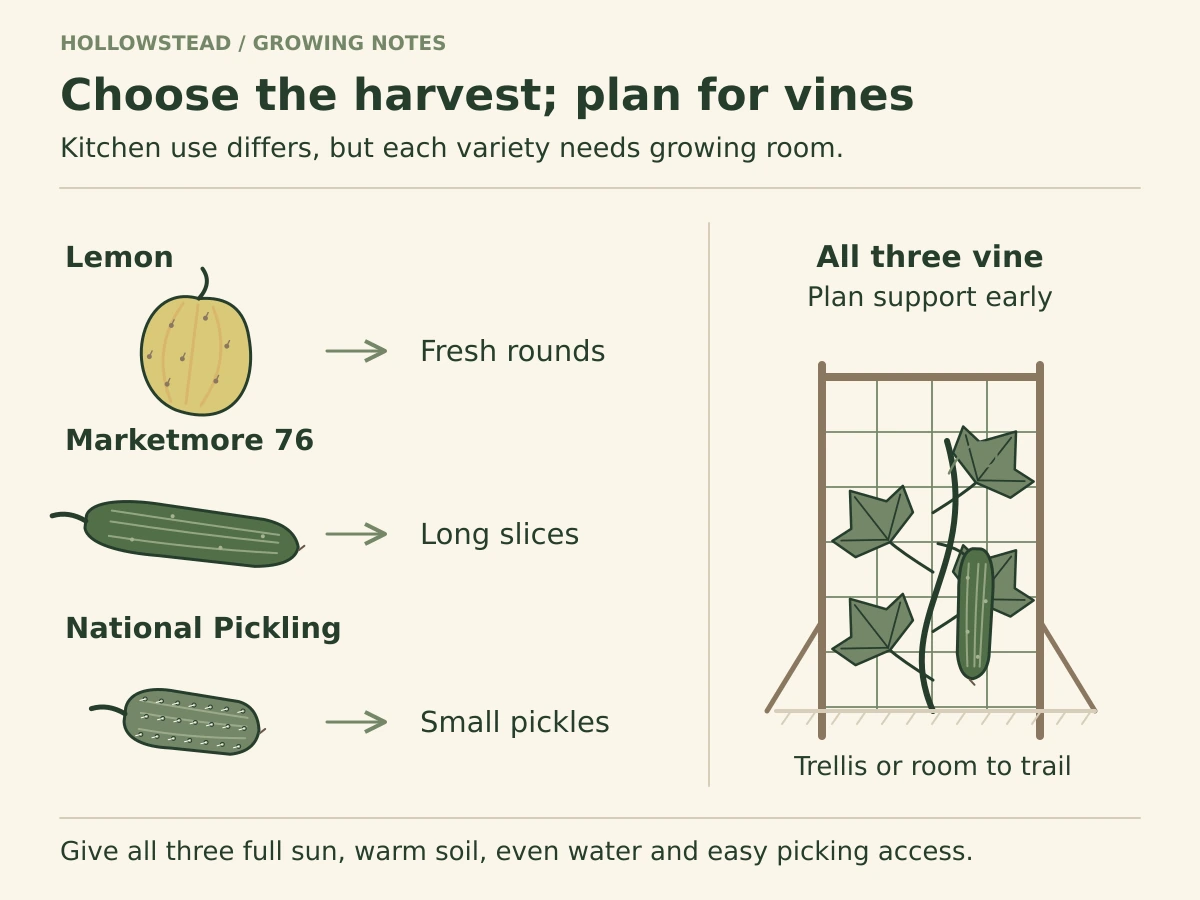
For a fresh-salad household: Marketmore 76 is the direct fit when long green slices are what you usually prepare. Lemon makes sense when its round shape and yellow color add something you will enjoy using. If a novelty fruit will mostly be left on the counter, choose the familiar form instead.
For a pickling project: National Pickling gives a focused harvest target. Begin with a tested recipe, note its required fruit size, and plan how you will check the vines often enough to catch that stage. Its name does not remove the need for sorting and timing.
For an occasional garden visit: Choose a manageable number of plants and accept that you may miss some ideal stages. Small-pickle targets require particularly frequent attention. A trellis helps you see fruit, but cannot hold a cucumber at the same size until the next weekend.
For a small patio: Decide whether you can provide sufficient root space, support and daily observation before deciding among these fruit types. None is a compact bush selection in Hollowstead’s listing. The container guide helps you work through that setup.
Compare timing and spacing
| Planning field | Lemon | Marketmore 76 | National Pickling |
|---|---|---|---|
| Hollowstead first-harvest estimate | About 65 days from sowing | About 67 days from sowing | About 50–70 days from sowing |
| Sowing depth | About 1 inch | About 1 inch | About 1 inch |
| Final plant spacing | About 18–24 inches | About 18–24 inches | About 18–24 inches |
| Light | Full sun | Full sun | Full sun |
| Support | Optional; useful for access | Optional; useful for access | Optional; useful for frequent picking |
The small numerical difference between 65 and 67 days is not a strong reason to choose one variety over another. Catalog estimates are not synchronized trials in your garden. A difference in soil warmth or establishment can outweigh two printed days. National Pickling’s broader window also reflects that a small usable fruit and a larger usable fruit are different harvest targets.
Spacing should be read with the growing system. Eighteen to twenty-four inches along a trellis can be a useful plant interval, but it is not permission to crowd every surrounding crop into that same space. Ground-grown vines require a larger dedicated area. Iowa State describes both ground and trellised systems and emphasizes matching room to the vine.[3]
If you are comparing the varieties yourself, give each a fair position. A plant shaded by a fence and a plant in open sun are not a meaningful variety trial. Label each sowing and record the first useful harvest, not just the first tiny fruit.
Planting and growing: the shared work
Sow after frost when the soil is warm; about 70°F at seed depth is a useful Minnesota Extension planting target.[4] Keep the seed zone evenly moist and thin to the intended number of plants. For a head start, transplant young seedlings gently with their root balls intact instead of raising a large tangled vine indoors.
Install supports before they are needed. Make sure you can reach both sides, guide new growth as it appears, and inspect fruit that might be caught in mesh. For a ground planting, define a walking edge that keeps feet away from vines.
Supply water to the roots consistently through fruiting, accounting for rain, soil type and container size. Make small, informed changes when growth is poor. More fertilizer will not resolve a cold start, lack of light or a waterlogged root zone.
The complete cucumber growing guide covers starting the crop, while trellising cucumbers helps you build around the available space. Choose the fruit type once; plan these shared tasks for the entire bed.
Pollination and growing problems
These garden cucumbers have male and female flowers. A female flower has the small cucumber-shaped ovary behind it; pollen must reach the flower for normal development. Male flowers appearing first is normal. Remove insect-excluding covers in time for pollinator access.[5]
When fruit fails to enlarge, start by checking flower type, bee access and recent weather. Insufficient pollination can affect fruit set and shape.[8] For sudden wilt, leaf lesions or chewing, inspect the plant rather than changing varieties in the middle of a diagnosis.
A mixed bed is useful for comparison, but avoid reading too much into one plant. A broken stem, an unevenly wet corner or different shading can make one variety look poor for reasons unrelated to its genetics. Check whether the same symptom appears throughout the bed and whether it began at the same time.
Use the cucumber pollination guide when flowers are the problem. For yellow, bitter or distorted fruit, use the fruit-quality troubleshooting guide. Remember that yellow is a normal part of Lemon’s eating-color progression; it has a different meaning on an aging green slicer.
A harvest routine for three types
Keep variety names visible. With several vines on one trellis, stems can weave together until it is hard to tell which plant owns a fruit. Clear labels near the plant base and a simple bed sketch help, especially if someone else picks for you.
Use a consistent picking route. Check the near side of the support, the far side, then low fruit hidden behind leaves. Put your desired harvest stage on a note: “Lemon: pale yellow and firm,” “Marketmore: firm green slicer,” or “National: recipe size.” A helper then has a stage to look for rather than only a plant name.
Keep fruit for different uses separate as you pick. A shallow container can hold fresh salad fruit; another can hold matched pickling sizes. Remove missed overgrown fruit during the same pass. If fruit repeatedly overshoots its desired stage, shorten the interval between checks or grow fewer plants that you can manage well.
For preserving, choose a tested recipe and follow it. The National Center for Home Food Preservation specifies firm cucumbers and sizes suited to the product.[6] A general statement that a cucumber “can be pickled” is not a substitute for that recipe.
Growing together and saving seed
You can grow all three beside one another for food. Cross-pollination does not turn a Lemon fruit into a long green cucumber that season. It changes the genetic possibilities in the seed, which may appear when that seed is grown.[9]
All three are Cucumis sativus. If you want seed that reliably retains a variety, arrange isolation or controlled pollination before flowers open. Seed Savers Exchange explains both distance isolation and protected hand pollination for cucumbers.[7] Separate packets at sowing do not keep pollen separate at flowering.
Also separate the harvest goals. Eating fruit is picked while immature; seed fruit must remain much longer. Mark selected seed fruit so it is not accidentally harvested. Once you have chosen a seed-saving method, follow its maturation, extraction and drying instructions rather than scooping soft seed from a cucumber prepared for lunch.
If seed saving is not the objective, place the varieties for convenient growing and eating. There is no need to complicate an ordinary mixed cucumber bed with a seed-production layout.
Choose one or a useful mix
For one variety, choose the role you will use most. For two, a fresh slicer plus National Pickling gives clearly different kitchen targets; Lemon plus Marketmore gives two forms for fresh salads. Growing Lemon plus National Pickling works when you want round fresh fruit and a separate pickle harvest.
All three can be worthwhile when you have the space and time, but three crowded, neglected vines are harder to learn from than two well-managed ones. Keep a note after harvest: which fruit did you actually reach for, which stage was easiest to catch, and which planting fit your routine? Those answers are more useful for next year’s seed order than a universal “best cucumber” ranking.
GROW FROM SEED
Grow this variety
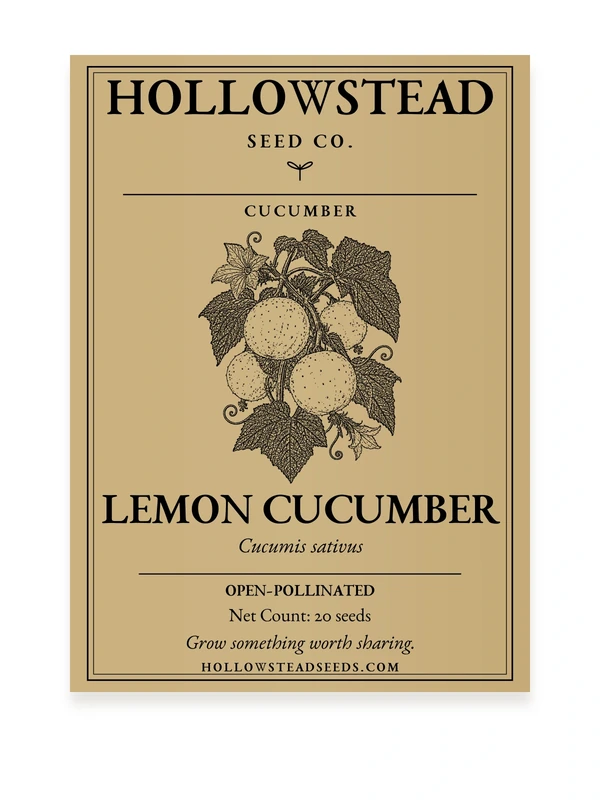
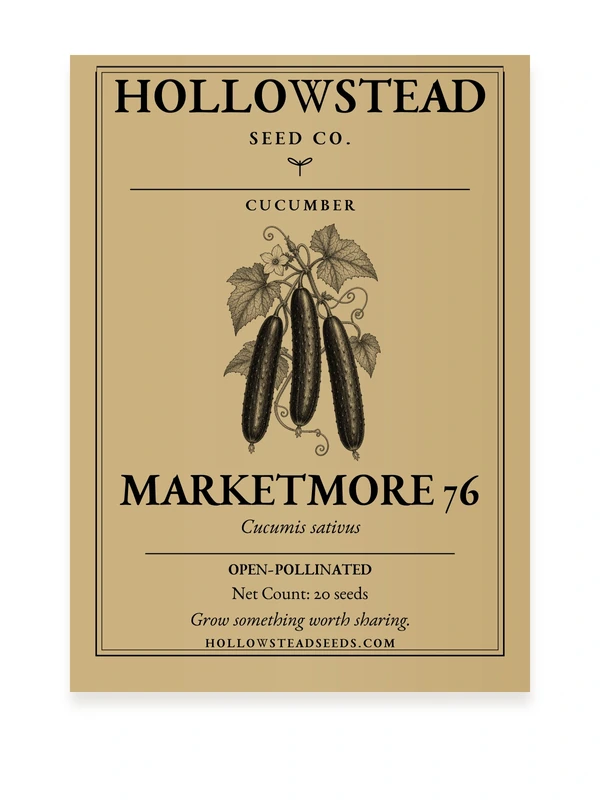
Lemon Cucumber Seeds, Marketmore 76 Cucumber Seeds and National Pickling Cucumber Seeds each come in a 20-seed packet.
HOLLOWSTEAD SEED
Marketmore 76 Cucumber Seeds
$3.99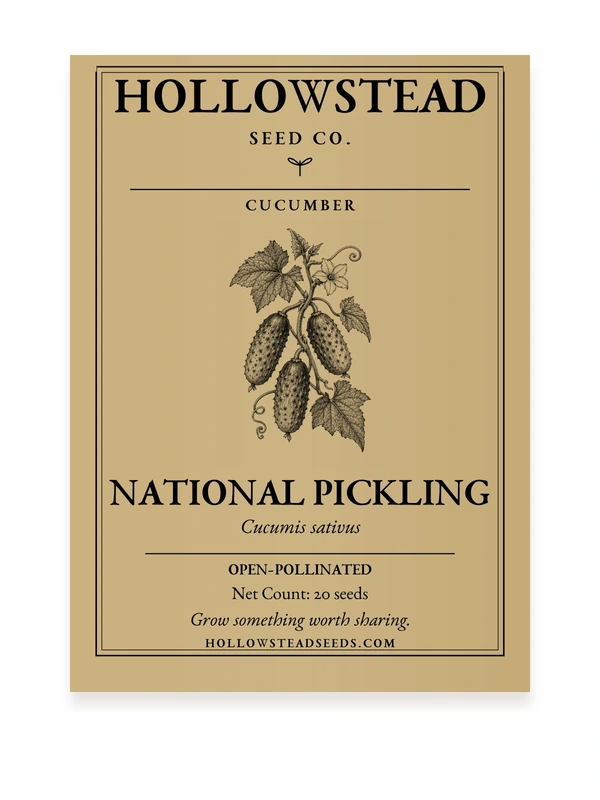
HOLLOWSTEAD SEED
National Pickling Cucumber Seeds
$3.99Frequently asked questions
Which of the three is best for fresh eating?
Marketmore 76 is the familiar long green slicer. Lemon offers round pale-yellow fruit. National Pickling can also be eaten fresh when picked while tender; choose the form and texture you enjoy.
Which is best for pickles?
National Pickling is the most focused choice for small pickling fruit. Select a tested recipe first and harvest to its cucumber type and size requirements.
Does Lemon Cucumber taste like lemon?
Its name describes its round shape and yellow color. Do not choose it expecting citrus acidity or use the name to make preservation decisions.
Can they grow on the same trellis?
Yes, if the support and spacing suit the total vine growth. Keep labels visible and allow a way to reach fruit from both sides.
Do they cross with one another?
They can cross because they are the same species. That matters for saved seed, not for turning this season’s fruit into a different variety.
Which takes the least space?
None of these is a dwarf bush cucumber in this collection. Support, spacing and how you manage the vines matter more than choosing the smallest-looking fruit.
Sources & further reading
- Cornell Cooperative Extension. Vegetable Varieties for Gardeners: Lemon cucumber. https://vegvariety.cce.cornell.edu/main/detail.php?filterBy=0&variety_id=684
- Cornell Cooperative Extension. Vegetable Varieties for Gardeners: Marketmore 76 cucumber. https://vegvariety.cce.cornell.edu/main/detail.php?filterBy=0&variety_id=687
- Iowa State University Extension and Outreach. Growing Cucumbers in the Home Garden. https://yardandgarden.extension.iastate.edu/how-to/growing-cucumbers-home-garden
- University of Minnesota Extension. Growing cucumbers in home gardens. https://extension.umn.edu/garden-and-home/yard-and-garden/gardening-in-minnesota/growing-cucumbers
- University of Maryland Extension. Growing Cucumbers in a Home Garden. https://extension.umd.edu/resource/growing-cucumbers-home-garden
- National Center for Home Food Preservation. Selection of Fresh Cucumbers. https://nchfp.uga.edu/how/pickle/general-information-pickling/selection-of-fresh-cucumbers/
- Seed Savers Exchange. Growing and saving cucumber seeds. https://seedsavers.org/grow-cucumber/
- University of Minnesota Extension. Fruits and vegetables that require pollination. https://extension.umn.edu/agriculture/specialty-crops/pollination/requirements
- Iowa State University Extension and Outreach. Will cucumbers cross-pollinate with other vine crops?. https://yardandgarden.extension.iastate.edu/faq/will-cucumbers-cross-pollinate-other-vine-crops
Hollowstead Growing Notes
A little help for your next growing season
Practical sowing advice, help choosing seeds, and occasional Hollowstead shop news. Usually one or two emails a month, plus a short welcome note.
Choose your topics and frequency after you confirm. Our guides and planting calendar are always free.