
PEPPER VARIETY GUIDE
Fish Pepper Growing Guide
Grow Fish Pepper with guidance on its normal variegation, warm seed starting, compact habit, canopy care, multicolor harvest stages, containers, Chesapeake history, and seed saving.
PeppersVariety guideBeginner → advanced
Published by Hollowstead Seed Co. · How this guide is prepared
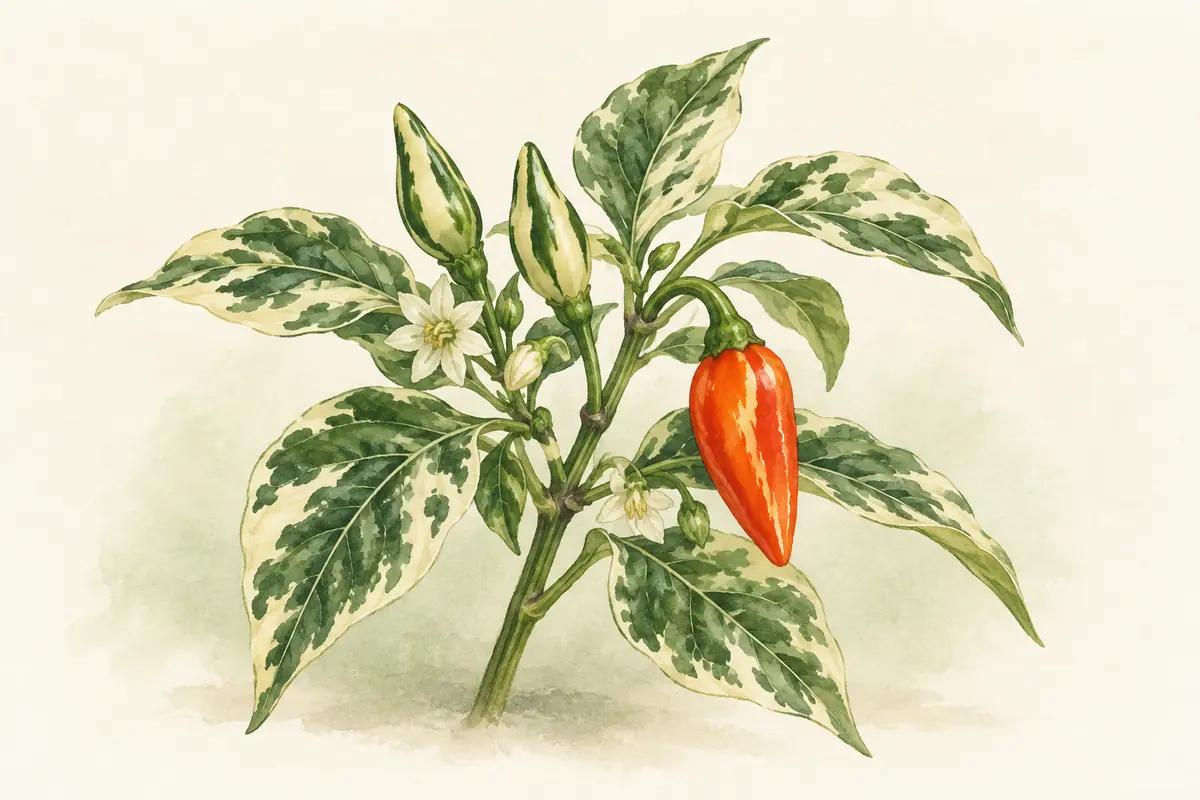
Quick answer
Fish Pepper is a historic hot Capsicum annuum with variegated foliage and fruit that changes dramatically as it ripens. Cornell describes 18–24 inch plants bearing 2–3 inch fruit that progress from cream with green striping through orange/brown striping to red.[1] Seed Savers documents its long association with Chesapeake Bay oyster and crab houses and its preservation through the Weaver family after receiving seed from artist Horace Pippin.[2]
Grow it as a warm-season pepper, but use its distinctive foliage and multistage fruit as management clues rather than assuming every pale patch is disease or every pale pepper is ripe.
Fish Pepper at a glance
| Trait | Useful reference |
|---|---|
| Type | Historic hot pepper; edible + ornamental |
| Species | Capsicum annuum |
| Plant habit | Compact; roughly 18–24 inches in Cornell/SSE descriptions |
| Foliage | Green-and-cream variegated |
| Fruit | About 2–3 inches; striped/multicolor while ripening |
| Final ripe color | Red |
| Heat | Hot; a variable 5,000–30,000 SHU cultivar reference range, not a test of this lot |
| Seed type | Open-pollinated heirloom |
| Current listing maturity | About 80–90 days from transplant; eating stage and full-red seed maturity differ |
| Sowing and spacing | Start about 8 weeks before transplant; ¼ inch deep; plants 12–24 inches apart |
- Display
- Variegated leaves + multicolor fruit
- Plant out
- Only after warm weather is established
- Container
- 5+ gallons is an easy full-size baseline
- Harvest range
- Striped immature to fully red mature
- Seed maturity
- Mark fully ripe isolated fruit
SAVE FOR SOWING DAY
Five-step crop plan for Fish Pepper
Open the sow-to-harvest plan
- StartStart indoors about 8 weeks before a realistic outdoor window; sow about ¼ inch deep and warm the seed medium. Guide details
- PlantHarden and transplant after frost danger, once nights stay above about 50°F; set a small stake or cage early. Guide details
- MaintainMaintain moisture and leafy cover; distinguish normal cream-green variegation from spreading injury before changing care. Guide details
- HarvestUse striped fruit for cooking if desired; fully red marked fruit supplies the strongest mature-seed cue. Guide details
- Next sowing or seedSelect healthy plants for the leaf and fruit traits you want; protect unopened pepper flowers if keeping identity and label crossing uncertainty. Guide details
- Space
- Current spacing is 12–24 inches; favor the wider end for airflow or broad cages.
- Timing
- Current listing says about 80–90 days from transplant; eating stages and fully red seed maturity are different.
Full growing guidehttps://hollowsteadseeds.com/fish-pepper-growing-guide/Seed packethttps://hollowsteadseeds.com/product/fish-pepper-seeds/Find planting dates by ZIP code
Variety reference photo
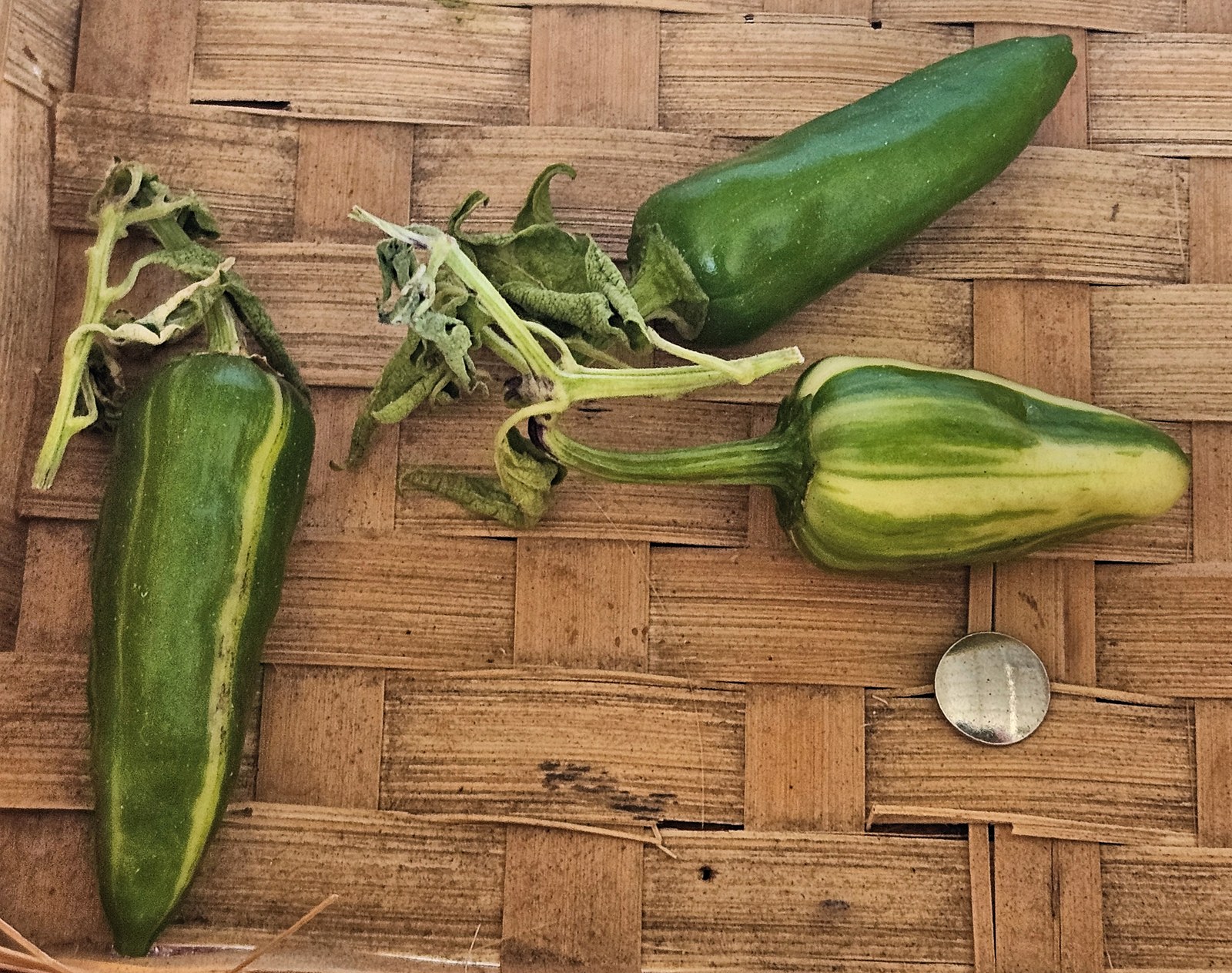
Fish Pepper variegation and growth habit
The foliage is part of the crop. Cornell and Seed Savers both describe compact plants with green-and-white variegation and fruit that can show striping during development.[1][2] The exact percentage of white on an individual leaf can vary, so learn the plant’s baseline before diagnosing discoloration.
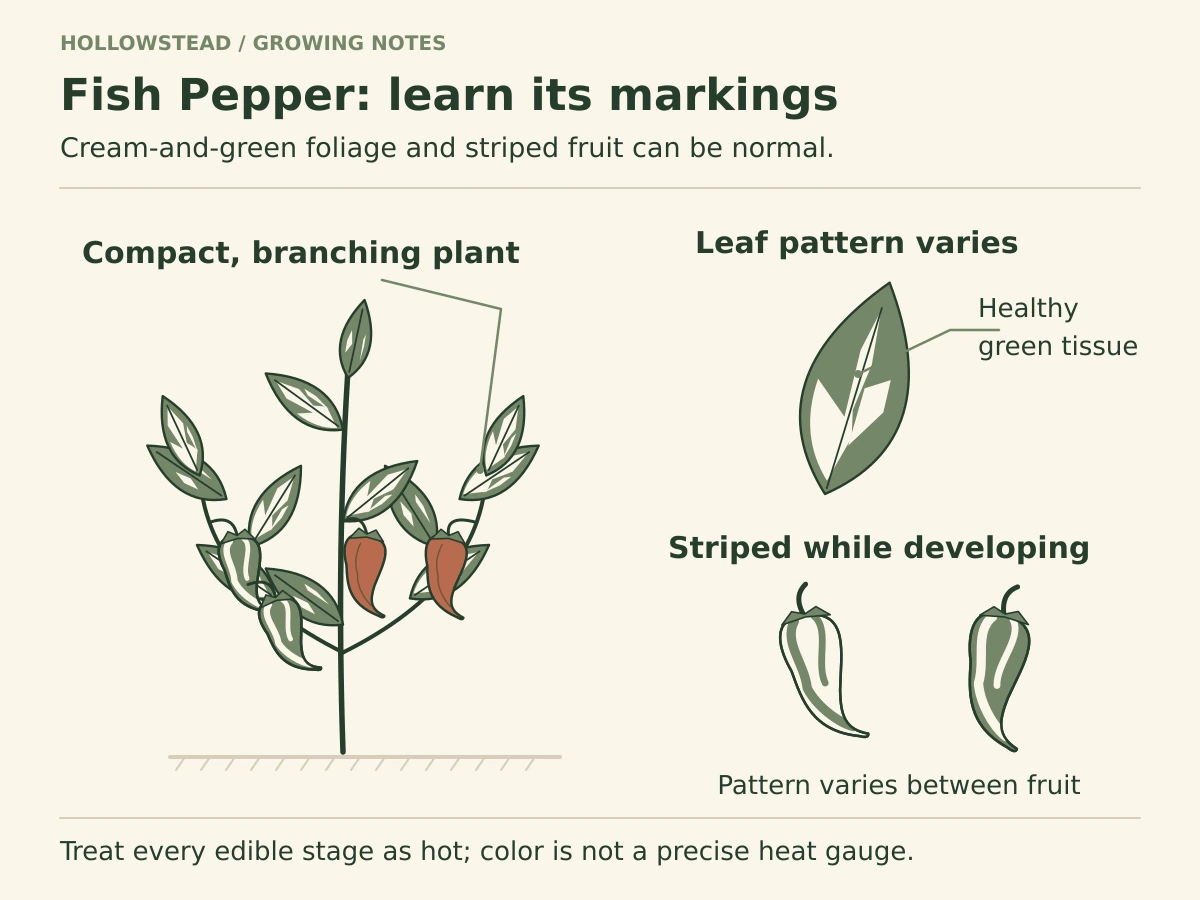 View full-size diagram
Use both pattern and plant condition. Cream-and-green markings can belong to healthy Fish Pepper foliage; brown dead tissue, new distortion, spreading spots, or stalled growth need a separate check. Compare new leaves over time rather than diagnosing from one pale leaf.[1][9]
Why Fish Pepper matters
Fish Pepper is closely tied to African-American foodways in the Mid-Atlantic. Seed Savers Exchange identifies it as a 19th-century African-American heirloom traditionally used in oyster and crab houses around Chesapeake Bay.[2] Their collection history connects the seed to Horace Pippin, who shared it with the Weaver family, and to William Woys Weaver, who later brought it into the Seed Savers Exchange network.
That history matters because the variety’s appearance makes it easy to market merely as an ornamental novelty. Fish Pepper is ornamental, but it also has a documented culinary and cultural history.
Starting and planting
Start indoors about 8 weeks before a realistic outdoor planting date; sow about ¼ inch deep and keep the root zone warm. Seed Savers recommends at least about 75°F in the seed-starting medium and gives 14–18 days as a common pepper germination window.[3] After emergence, strong light becomes the priority.
Harden gradually and transplant only after frost danger has passed and conditions have warmed. Minnesota Extension recommends nighttime lows above about 50°F for planting peppers outside.[4] The current Hollowstead spacing is 12–24 inches between plants; use the wider end in a humid garden or with broad cages.
If the tray is slow, use the pepper germination troubleshooting guide to check warmth, moisture, and elapsed time before starting over.
After emergence: light, warmth and airflow
Set a timer for 14–16 hours of overhead light and 8–10 hours of darkness. Adjust fixture distance to its output and the plant response; stretching suggests inadequate light, while bleaching or scorch suggests too much intensity or heat.[8]
Vent and remove the humidity cover as shoots emerge. Reduce germination heat and aim for a root-zone temperature around 70°F; measure the mix rather than assuming room temperature equals root temperature. Keep the tray away from cold windowsills and drafts; reduce heat only as far as needed to maintain that growing target. Use a thermostat if supplemental warmth is still necessary. This growing setup is cooler than an 80–90°F germination mat. Keep air moving gently and water when the surface begins to dry, without leaving pots standing in water.[4]
Canopy and support
Plant a hardened, stocky seedling once frost danger is past and nights stay above 50°F. Harden over roughly 7–14 days, slowing down in wind, heat or cold. Keep the root ball intact and set it at its previous soil level. Water in thoroughly, then check the plug and surrounding soil separately for the first week; a dry plug can sit inside otherwise damp ground.
Fish Pepper’s compact habit does not eliminate the value of support. A small stake or cage keeps branches upright as fruit load increases and protects the leaf canopy that shades developing peppers. Missouri Extension notes that pepper support helps prevent splitting and reduces sunscald by keeping plants upright.[5]
Because part of the foliage contains less chlorophyll, avoid the temptation to strip leaves aggressively for a cleaner ornamental shape. Healthy green tissue is doing the plant’s photosynthetic work and also protecting fruit from intense sun.
Three checks as the plant develops
- After transplanting: watch for new growth and compare markings across several leaves. Keep a photo of a healthy leaf as your baseline rather than feeding until all foliage turns green.[1]
- When flowers open: check water, light, and recent temperatures if blossoms drop. General pepper guidance links poor set to temperature extremes and root-zone stress; color variegation by itself does not explain a missed crop.[11]
- As fruit fills: support leaning branches while keeping leaves over the fruit. If a movable pot faces reflected afternoon heat, a less exposed position can help while retaining ample daily sun.[5][10][11]
Harvest color stages
Fish Pepper is unusually useful for teaching the difference between edible maturity and seed maturity. Cornell describes a sequence from cream/green-striped fruit to orange/brown striping and finally red.[1]
Fish Pepper harvest stages and variable heat
- Cream or striped fruit is immature, edible and potentially hot; red fruit is fully ripe. Color is not a reliable heat scale.
Heat and handling
Fish Pepper has a broad cultivar reference range of 5,000–30,000 SHU. That is a cultivar comparison, not a measurement of Hollowstead’s lot or a way to predict one pod’s heat.
Treat fruit at every edible stage as hot pepper. Wear gloves for processing, keep hands away from eyes and face, and wash tools and surfaces afterward. Add a little to a dish, then adjust; neither leaf markings nor fruit color is a precise heat gauge.
Seed Savers describes traditional seafood use along with hot sauce, salsa, pickling, and drying.[2] Keep fresh cooking separate from storage decisions: use a tested method for any dried, pickled, or oil-packed product.
Growing Fish Pepper in containers
Fish Pepper’s foliage makes a container useful visually before pods are ready. Keep one plant per 5–10-gallon pot, at least about 12 inches deep, with drainage holes and a small cage or stake. Maryland Extension lists 5 gallons as the pepper minimum; larger volume gives more room and a buffer against drying.[6] Choose nearer 10 gallons where summer heat complicates watering, and move surplus seedlings to separate pots.
A movable container has another advantage: during prolonged extreme heat, you can shift it away from reflected afternoon heat without turning the plant into a shade crop. The goal is still abundant sun, not permanent dimness.
Saving seed from this open-pollinated pepper
A practical controlled seed lot
Bag unopened flower buds with breathable blossom bags before insects enter, gently tap flowers as they open, and mark the resulting fruit. Keep bagged seed fruit separate from unprotected harvest. For ongoing variety maintenance, Seed Savers recommends seed from 5–20 plants where space allows; a single plant can produce viable seed but maintains a narrower sample. Select healthy, typical parents; keep source/lot, parent number and year with each drying batch. Cut fully colored, softening seed fruit open, remove seed, and dry it in a thin layer out of direct heat. No fermentation is needed for peppers. Once completely dry, store cool and dry in a sealed labeled container, and test a sample before sowing.
Select for your goal: Truelove reports retaining some less-variegated Fish Pepper plants in its own population because it has found them vigorous and productive. Before discarding a healthy lightly patterned plant, decide whether you value leaf markings, vigor, ripe-fruit traits, or a balance. Save from several healthy representatives and record crossing uncertainty.[13]
Fish Pepper is open-pollinated, but that does not mean seed is automatically pure when several compatible peppers flower nearby. Pepper flowers can self-pollinate, yet insects also carry pollen. Seed Savers recommends 300–1,600 feet of isolation for pepper seed production depending on circumstances and describes blossom bags or whole-plant mesh barriers when that distance is unrealistic.[3]
Cornell Cooperative Extension likewise recommends covering unopened pepper flowers with breathable bags when a home grower needs controlled pollination.[7] Mark the isolated blossom/fruit so you do not accidentally eat your seed crop.
Leave selected fruit until it has reached its final red color and begins to soften, then clean and dry the seed thoroughly.[3] If you are trying to preserve Fish Pepper rather than merely grow a fun second generation, save from several healthy plants rather than selecting one oddball plant that may not represent the variety well.
Variegation or trouble?
The location and progression of a mark are more useful than its color alone. Check the whole plant and both leaf surfaces before treating it.
| What you see | Check | Action |
|---|---|---|
| Cream/white patches with healthy green tissue | Normal growth, firm leaves, and similar markings on other leaves | Observe and photograph. Variegation is expected; do not remove healthy patterned leaves simply to make the plant uniformly green.[1] |
| Broad yellowing or pale new growth | Moisture, drainage, recent fertilizer, and whether older or younger leaves changed first | Correct obvious root stress and seek a diagnosis if it persists. Adding fertilizer by color alone can miss the cause.[4][9] |
| Mottling with distortion or stunting | Leaf undersides for pests, nearby affected plants, and recent spray exposure | Keep this distinct from normal variegation. Photograph symptoms and ask Extension to distinguish pest, disease, and exposure injury before treatment.[9] |
| Spots become brown and spread | Wet foliage, soil splash, spots on fruit, and change over several days | Avoid splashing the canopy and get the pattern identified; several pepper diseases can begin as small spots.[4][9] |
| Bleached or papery injury after stronger sun | Recent move outdoors, heat, and the exposed side of leaves or fruit | Harden more gradually and preserve canopy cover. Existing scorched tissue will not turn green again.[10] |
Keep the harvest in good condition
Clip fruit cleanly, cool it out of the sun, and refrigerate for short holding; aim to use it within about a week. Long cold storage can pit pepper skin. Keep fruit dry until washing for preparation and discard decay. Freeze excess using Extension instructions; dried, pickled and oil-packed peppers each require their own tested preservation method.[4]
A leafy plant with dropping blossoms needs a different check from a slow seed tray. Work through why pepper flowers fall without setting fruit.
For a dark, sunken patch at the blossom end of a fruit, use the blossom-end-rot diagnosis and prevention guide before adding a supplement.
Sourced grower observations
These are attributed experiences from other growers, checked against the linked horticultural references. They are not Hollowstead trials of the seed offered here.
In a Fish Pepper grower discussion, Wisconsin gardener esox07 saw cream flecks appear only as plants grew; another grower, beesneeds, saw marked differences among individual seedlings. Cornell’s cultivar description confirms variegated foliage and fruit as expected traits. Pale markings can be normal, but inspect spreading brown lesions, wilting, or damaged tissue separately; the anecdotes do not diagnose disease or predict this lot’s uniformity.
GROW FISH PEPPER
Put the guide to work.
Fish Pepper earns its place twice: as a useful hot pepper with Chesapeake culinary history and as one of the most visually distinctive edible plants in the Hollowstead collection.
HOLLOWSTEAD SEED
Fish Pepper Seeds
$3.99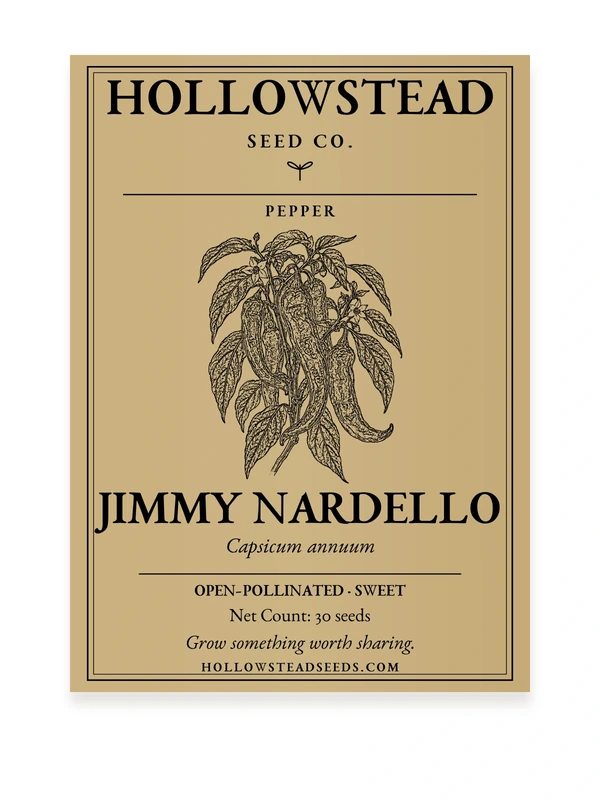
HOLLOWSTEAD SEED
Jimmy Nardello Sweet Pepper Seeds
$4.49KEEP LEARNING
Related Hollowstead guides
PEPPER SEED STARTING
Growing Peppers From Seed: The Complete Guide
Grow peppers from seed through harvest with warm germination, strong seedlings, soil preparation, transplant timing, steady moisture, sensible fertility, fruit-set troubleshooting, disease prevention, and harvest care.
Read the guide
HARVEST GUIDE
When and How to Harvest Peppers
Choose the right pepper harvest stage for green eating, full ripe flavor, continued production, storage, or seed saving, with specific cues for Jimmy Nardello and Fish Pepper.
Read the guide

CONTAINER GUIDE
Growing Peppers in Containers
Grow productive peppers in containers with enough root volume, airy potting mix, drainage, sun, steady water, moderate fertilizer, branch support, root-zone heat management, and troubleshooting.
Read the guideFrequently asked questions
Is Fish Pepper foliage supposed to be white and green?
Yes. Cream-and-green variegation is a defining trait. Distortion, spreading lesions, uniform yellowing, or stunting should still be investigated separately.
Is Fish Pepper hot?
Yes. Treat it as a hot pepper. Exact heat varies among fruit and growing conditions.
Can I eat the pale striped peppers?
Yes. They are immature but edible. Fully red fruit is the mature stage and the better choice for seed saving.
Can Fish Pepper grow in containers?
Yes. Its compact habit and ornamental foliage suit containers well; around five gallons is a practical minimum for a full-size pepper.
Sources & further reading
- Cornell Cooperative Extension Vegetable Varieties for Gardeners: Fish https://vegvariety.cce.cornell.edu/main/detail.php?filterBy=0&variety_id=3140
- Seed Savers Exchange Fish Pepper (Organic) https://shop.seedsavers.org/fish-organic-pepper
- Seed Savers Exchange Growing Guide: Peppers https://seedsavers.org/grow-pepper/
- University of Minnesota Extension Growing peppers in home gardens https://extension.umn.edu/garden-and-home/yard-and-garden/gardening-in-minnesota/growing-peppers
- University of Missouri Extension Growing Sweet Peppers in Missouri https://extension.missouri.edu/publications/g6372
- University of Maryland Extension Growing Vegetables in Containers and Salad Tables https://extension.umd.edu/resource/growing-vegetables-containers-and-salad-tables
- Cornell Cooperative Extension Saving the Future, One Seed at a Time https://cce.cornell.edu/orleans/saving-future-one-seed-time
- University of Maryland Extension — Starting Vegetable Seeds Indoors https://extension.umd.edu/resource/starting-vegetable-seeds-indoors
- University of Minnesota Extension. Pepper leaf symptoms and diagnostic comparisons. https://apps.extension.umn.edu/garden/diagnose/plant/vegetable/pepper/leavesdiscolored.html
- South Dakota State University Extension. Sun injury on leaves and fruit; scorched tissue does not recover. https://extension.sdstate.edu/leaf-scorch-and-sunscald-garden
- University of Maryland Extension. Water, light, temperature, and pepper fruit set. https://extension.umd.edu/resource/poor-blossom-and-fruit-set-vegetables
- Truelove Seeds — Fish Pepper producer and population note Its own less-variegated selection for vigor and productivity. https://trueloveseeds.com/products/fish-pepper
Hollowstead Growing Notes
A little help for your next growing season
Practical sowing advice, help choosing seeds, and occasional Hollowstead shop news. Usually one or two emails a month, plus a short welcome note.
Choose your topics and frequency after you confirm. Our guides and planting calendar are always free.