
TROUBLESHOOTING
Tomato Seedlings Are Leggy: Causes, Fixes & Prevention
Leggy tomato seedlings usually mean the plant is growing faster than the available light can support. Learn how to diagnose the cause, rescue recoverable plants, and prevent the problem next time.
TomatoesTroubleshootingBeginner → advanced
Published by Hollowstead Seed Co. · How this guide is prepared
Quick answer
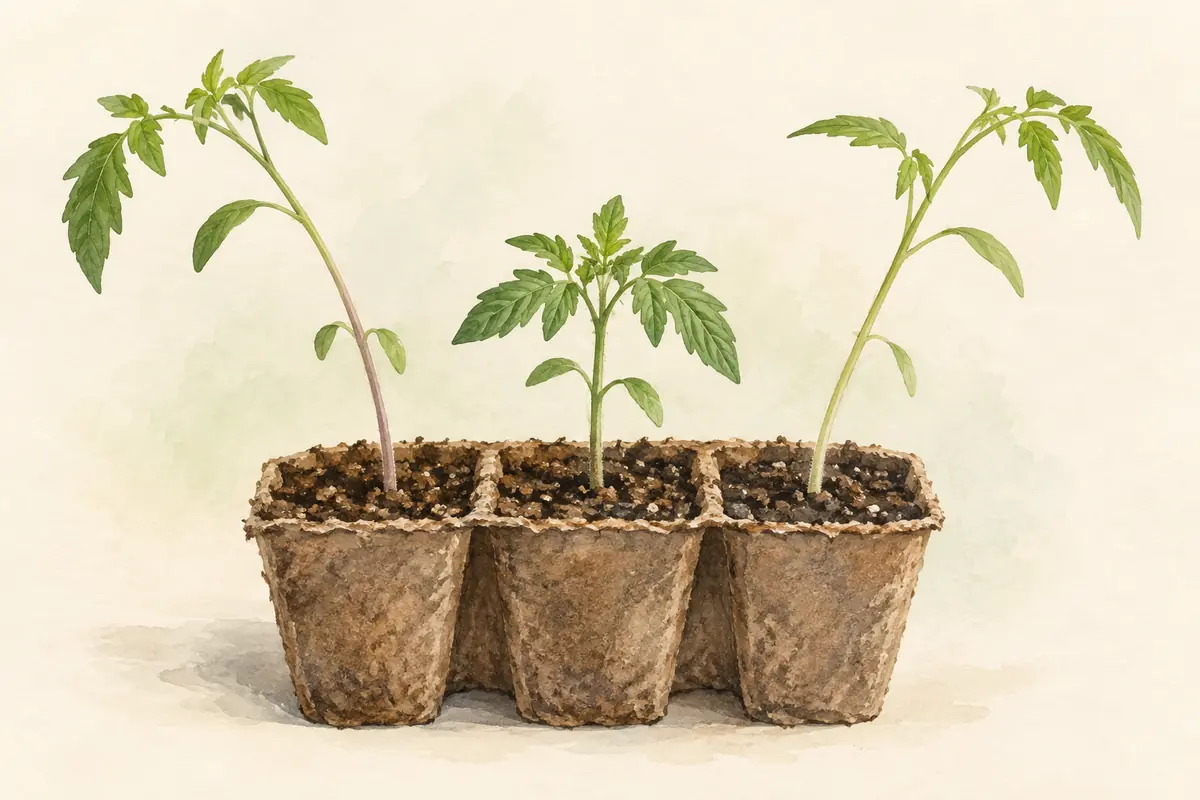
If tomato seedlings are tall, thin, widely spaced between leaves, or leaning hard toward a light source, inadequate usable light is the first thing to investigate. Extension sources consistently identify insufficient light as the most common cause of leggy seedlings.[1][2][3]
Fix the environment before trying cosmetic tricks: increase light intensity, correct fixture placement, reduce crowding, and stop giving emerged seedlings unnecessary germination heat. Tomatoes are unusually forgiving because they can form roots from buried stem tissue, so moderately stretched seedlings can often be potted deeper and recover well.[4][5]
But not every weak seedling should be saved. A plant with a pinched/water-soaked stem at the soil line, rotting roots, or active damping-off disease needs a different response—and sometimes restarting is the better choice.[6]
At a glance
| Issue | What to know |
|---|---|
| Most common cause | Insufficient usable light |
| Other contributors | Too much warmth with weak light, crowding, overwatering, or excess fertilizer |
| Usually fixable? | Often yes, if the stem is intact and the roots are healthy |
| Best rescue step | Improve light first, then pot seedlings deeper if they need more root space |
| When to restart | If seedlings are damping off, collapsing at the soil line, or badly compromised |
| Prevention | Strong light, proper spacing, moderate temperatures, and prompt potting up when needed |
| What you see | First action |
|---|---|
| Long but firm, intact stem | Improve light and airflow; pot a healthy tomato stem deeper if needed. |
| Pinched, dark, collapsing stem at soil line | Suspect damping off; remove affected seedling and restart in clean mix. |
| Very stretched and repeatedly falling | Check light setup and time remaining; a fresh sowing may be better. |
What does “leggy” actually mean?
Leggy seedlings have elongated stems and long internodes—the sections of stem between leaves. Horticulturally, this kind of stretching is associated with etiolation or shade-avoidance responses when light is insufficient for compact growth.[2]
A leggy tomato seedling may show:
- a long bare stem below the first true leaves;
- large gaps between later leaves;
- leaning toward a window or lamp;
- a stem too weak to hold the foliage upright;
- neighboring seedlings tangling together;
- pale color when low light is severe.
The word “leggy” describes the shape. It does not tell you the cause by itself.
The most common cause: not enough usable light
Penn State states plainly that seedlings become leggy and fragile when they do not receive enough light.[1] Illinois Extension likewise identifies insufficient light as the most common reason home-grown seedlings stretch.[2]
Light problems can happen even when a room looks bright to you.
Human eyes adapt extremely well to dim indoor light. A tomato seedling does not care whether the room feels cheerful—it responds to the actual quantity of photosynthetically useful light reaching its leaves.
Common ways seedlings end up light-starved
- relying on a bright window during short/cloudy days;
- grow lights hung too far above the canopy;
- a weak fixture covering too large an area;
- lights running for too few hours;
- old fluorescent tubes that have lost output;
- taller plants shading shorter ones;
- crowded cells creating mutual shade.
Light duration matters, but intensity matters too
Extension seed-starting guidance commonly recommends about 14–16 hours of artificial light daily for seedlings.[2][3][7]
But 16 hours of weak light is still weak light.
That is why Hollowstead does not give one universal “hang your grow light exactly X inches above the seedlings” rule. Fixture output varies dramatically. A small fluorescent shop light, a low-watt LED strip, and a high-output horticultural LED can all require different distances.
Better cues than a universal distance
Look for:
- compact leaf spacing;
- stems thickening as the plant grows;
- plants growing mostly upward instead of leaning sideways;
- normal green color;
- leaves not bleaching or scorching at the top.
Use your fixture manufacturer’s seedling recommendation as the starting point, then adjust based on plant response.
Warmth can make a light problem worse
Temperature controls growth rate. Penn State’s seedling guidance notes that warmer conditions speed growth while cooler temperatures slow it.[1]
That creates a useful way to understand legginess:
If warmth is pushing fast growth but light cannot supply enough energy for compact development, stems stretch.
This does not mean “cold seedlings are always better.” Tomatoes still need appropriate warmth. It means you should not leave emerged seedlings sitting on maximum germination heat while giving them mediocre light.
A practical post-emergence range around 65–75°F days and roughly 60–65°F nights is consistent with Extension transplant guidance.[1]
Crowding causes a second kind of light problem
Several seedlings in one cell can be sitting directly under a good grow light and still stretch because their own leaves shade one another.
Illinois Extension specifically notes that crowded seedlings compete for light and become leggy.[2]
Thin or separate seedlings before they form a dense canopy. If your tray has uneven height, raise the shorter cells or reorganize containers so the tallest plants are not shading everything else.
Too much nitrogen or overwatering can contribute to weak growth
Match fertilizer to the mix and plant stage, and let excess water drain. Extra fertilizer will not correct inadequate light. Overwatering can stress roots and increase damping-off risk.[2][3]
If a seedling is tall and pale/yellow, do not automatically add fertilizer. First check:
- root health;
- media saturation;
- light;
- temperature;
- whether the mix already contains nutrients.
Leggy or damping off? Learn the difference
These problems can both produce a fallen seedling, but they are not the same.
Leggy seedling
- stem is long and thin but generally intact;
- plant leans or flops;
- roots may still be healthy and white;
- often points toward light;
- usually remains green/alive.
Damping-off seedling
- stem may look pinched, water-soaked, brown, or thread-thin at soil level;
- seedling collapses suddenly;
- roots may be rotted or absent;
- fuzzy fungal growth may appear under humid conditions.[6]
A leggy tomato can often be rescued. A seedling actively collapsing from damping off is rarely repaired by simply burying it deeper.
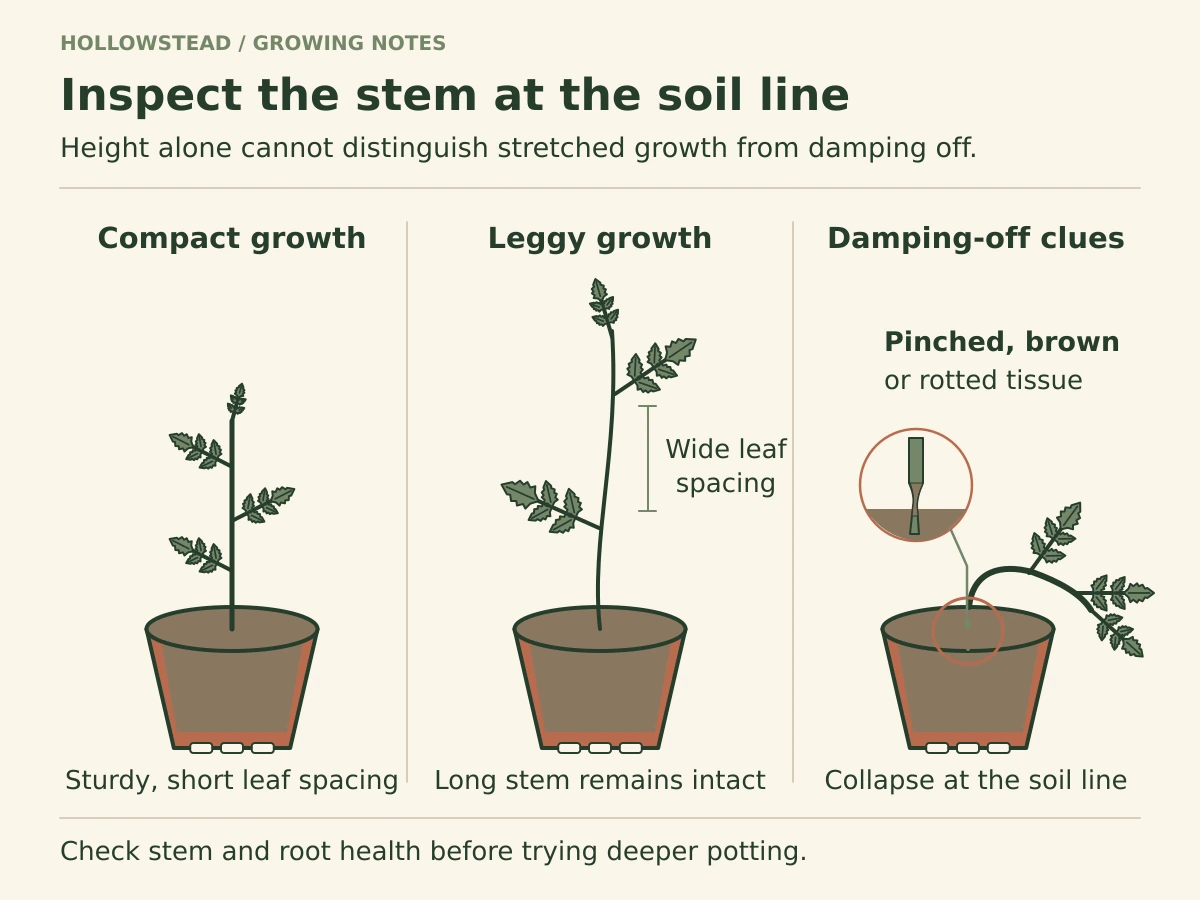 View full-size diagram
Fast diagnosis: rescue or restart?
Use the quick rescue or restart check above to separate an intact, stretched stem from a collapsed stem. Then inspect the root ball: a pale, stalled, root-bound plant may need a larger pot and a check of moisture, mix fertility, light, and temperature before adding fertilizer. A rotted root system or stem calls for fresh seed and clean mix, not deeper potting.[6]
Can leggy tomato seedlings recover?
Often, yes.
Tomatoes are especially forgiving because buried stem tissue can form adventitious roots.[4][5]
A moderately stretched plant can become a perfectly productive garden tomato if you correct the light problem and give it an appropriate root environment.
Rescue plan
- Fix the light first. Otherwise the plant simply stretches again.
- Reduce crowding. Give leaves unobstructed access to light.
- Remove unnecessary bottom heat after germination. Do not intentionally chill the plant; just stop forcing maximum germination warmth.
- Pot up if the roots/cell need more space. Tomatoes can be set deeper in the new pot.
- Add gentle airflow. Normal air movement helps seedlings acclimate to mechanical stress, but do not blast them with a fan.
- Continue normal nutrition only if needed. Do not try to “feed the stem thicker” with excess fertilizer.
How to pot a leggy tomato seedling deeper
When the seedling has true leaves and needs a larger container:
- Fill the new container partway with fresh potting mix.
- Remove the seedling gently by handling the root ball or leaves rather than crushing the stem.
- Set the root ball lower than it sat before.
- Remove any leaves that would end up buried.
- Fill mix around a portion of the elongated stem.
- Leave the growing tip and healthy leaves above the surface.
- Water the mix in gently.
University Extension guidance supports deep planting and trench planting for tomatoes because buried stems form roots.[4][5]
Do not bury the growing tip
The goal is to shorten the exposed stem, not bury the active top growth.
Tomato transplant depth with leaves kept above the final soil line
- Remove lower leaves, place the healthy tomato stem below the new finished soil line, and keep all remaining leaves above the mix. Do not bury a diseased stem.
Should you stake leggy seedlings indoors?
A temporary stake can stop a seedling from snapping, but it does not solve the cause.
If you need to prop up a plant while you correct its light and potting situation, use a small support loosely. Do not mistake a stake for treatment.
Should you brush tomato seedlings or use a fan?
University of Maryland notes that gently brushing tomato transplants can help control height and increase stockiness.[7]
Gentle mechanical movement can be useful, but it is secondary to light. A fan does not compensate for an underpowered grow light.
If using airflow:
- choose gentle movement;
- avoid drying cells excessively;
- do not point a strong fan at tiny seedlings 24 hours a day.
When is restarting better than rescue?
Restart when the cost of nursing a poor seedling is higher than the time you have left.
Consider restarting if:
- damping off has damaged the stem/root system;
- the seedling is extremely weak and repeatedly collapses;
- roots are severely rotted;
- the plant has been badly stressed for weeks and fresh seed can catch up;
- you still have enough time before the transplant window to produce a better plant.
The calendar matters
If you discover leggy seedlings three days before transplant season, correcting light and planting deeply may be reasonable.
If you discover severely stretched seedlings eight weeks before outdoor planting, restarting may give you a stronger plant with less work.
A cause → symptom → correction table
| What you see | Likely cause to investigate | First correction |
|---|---|---|
| All seedlings tall despite grow light | Fixture weak/too far away; too warm | Improve intensity/placement; review temperature |
| Center seedlings taller than edge | Crowding/shading | Thin/re-space trays |
| Tall + pale older leaves | Light + possible nutrient shortage | Fix light, check mix fertility/root health |
| Tall + constantly wet media | Overwatering/root stress | Improve drainage/watering rhythm |
| Thick enough stem but very tall | Started too early / extended indoor time | Pot up, increase space/light, reassess sowing schedule |
Prevention: build a seed-starting system that makes compact plants easy
1. Do not start tomatoes too early
University Extension recommendations commonly put tomato seed starting about 5–8 weeks before transplanting, depending on system and region.[4][7][8]
Starting months early turns lighting, watering, and root space into a much harder problem.
2. Put lights in place before seeds emerge
Do not wait for stretching to begin.
Have the light operating when the first green hooks appear.
3. Use a timer
A consistent 14–16 hour light schedule is easier with an inexpensive outlet timer.[2][3]
4. Keep the canopy close to one height
Use blocks/trays to raise shorter plants rather than moving the entire light farther away because one tomato has become tall.
5. Separate germination conditions from seedling conditions
Warm and humid is useful while seeds are germinating. Strong light, airflow, and less extreme warmth matter after emergence.
6. Do not crowd cells
Thin or transplant once true leaves develop and plants begin competing.[2][4]
What if the seedling has already fallen over?
First look at the stem where it meets the soil.
Stem healthy, just bent/floppy
- improve light;
- pot deeper if appropriate;
- use temporary support if needed;
- let the plant rebuild under better conditions.
Stem pinched/rotted at soil line
Treat as possible damping off rather than a simple light issue.[6]
What if only one variety is leggy?
Cultivars can differ in natural internode length and vigor, but a single leggy variety can also be:
- on the edge of the light footprint;
- germinated earlier than the rest;
- growing in a wetter cell;
- less crowded or more crowded;
- genetically taller at the seedling stage.
Before deciding that “this cultivar is always leggy,” rotate the tray and compare environment.
Advanced grower note: photomorphogenesis, not just “reaching for light”
Garden advice often says a seedling “reaches for light.” That is useful shorthand, but plant architecture is controlled by a network of light and temperature signals.
Low usable light changes stem elongation and leaf expansion. Crowding changes the ratio and direction of light reaching the plant. Temperature changes growth rate. The final shape is the combination.
You do not need to understand every hormone pathway to manage it. You need to manage the inputs the plant is responding to.
GROW THESE TOMATOES
Put the guide to work.
Choose a variety that fits the way you want to grow and harvest, then use the guide above as your reference through the season.
HOLLOWSTEAD SEED
Black Cherry Tomato Seeds
$4.49
HOLLOWSTEAD SEED
Principe Borghese Tomato Seeds
$4.49
HOLLOWSTEAD SEED
Yellow Pear Tomato Seeds
$4.49
HOLLOWSTEAD SEED
Pineapple Tomato Seeds
$4.49KEEP LEARNING
Related Hollowstead guides

SEED STARTING
The Complete Guide to Growing Tomatoes From Seed
Start tomato seeds with confidence. This guide covers the quick version first, then goes deep on temperature, light, watering, potting up, hardening off, transplant timing, containers, and common seedling problems.
Read the guide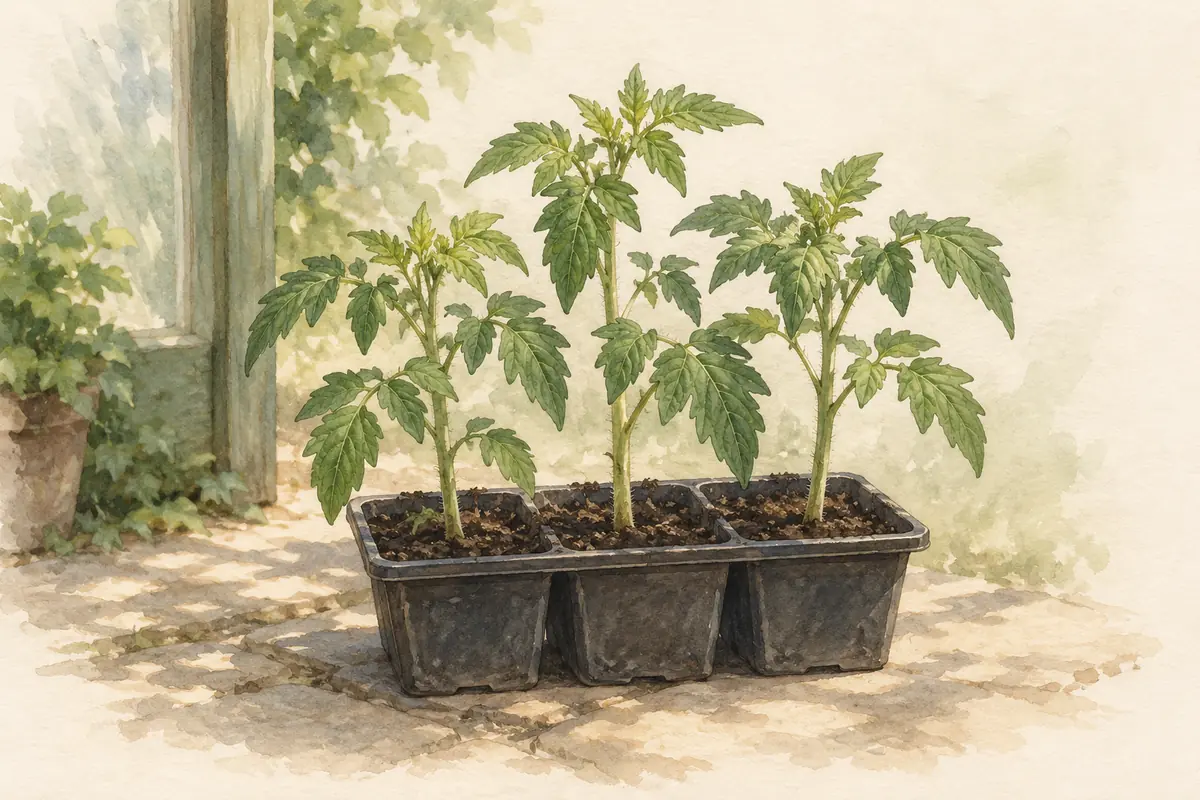
TRANSPLANTING
How to Harden Off Tomato Seedlings Without Stunting Them
Indoor tomato seedlings need time to adjust to full sun, wind, temperature swings, and faster drying. This guide explains a flexible hardening-off process that protects plants without deliberately starving or stunting them.
Read the guide
GARDEN BASICS
What “Days to Maturity” Actually Means for Tomatoes and Other Garden Crops
Days to maturity is a planning estimate, not a harvest appointment. Learn when the count starts, how transplanted and direct-sown crops differ, and how weather, containers, and transplant stress change the real timeline.
Read the guideFrequently asked questions
Will leggy tomato seedlings ever thicken up?
Should I pinch the top off a leggy tomato seedling?
Usually not as the first response. Fix light and growing conditions first. Topping changes plant architecture and is unnecessary for ordinary seedling stretch.
Can I bury a tomato seedling all the way to the first leaves?
Are purple stems a sign the seedling is too leggy?
No. Purple coloration and legginess are separate observations. Evaluate light, temperature, roots, nutrition, and overall growth rather than diagnosing by one color.
Does a fan fix leggy seedlings?
No. Gentle airflow can help acclimation and stockiness, but inadequate light remains inadequate light.
Should I turn off the heat mat after tomatoes sprout?
Usually the seedling no longer needs maximum germination heat. If the room is already warm enough for seedling growth, removing bottom heat can make management easier.
Sources & further reading
- Penn State Extension. Seed and Seedling Biology. https://extension.psu.edu/seed-and-seedling-biology
- Illinois Extension. What’s wrong with my seedlings? Troubleshooting seed starting problems. https://extension.illinois.edu/blogs/good-growing/2022-02-25-whats-wrong-my-seedlings-troubleshooting-seed-starting-problems
- University of Minnesota Extension. The case of the curious leggy, yellow seedlings. https://extension.umn.edu/news/case-curious-leggy-yellow-seedlings
- University of Minnesota Extension. Growing tomatoes in home gardens. https://extension.umn.edu/vegetables/growing-tomatoes
- University of Maryland Extension. Growing Tomatoes in a Home Garden. https://extension.umd.edu/resource/growing-tomatoes-home-garden
- University of Minnesota Extension. How to prevent seedling damping off. https://extension.umn.edu/solve-problem/how-prevent-seedling-damping
- University of Maryland Extension. Starting Vegetable Seeds Indoors. https://extension.umd.edu/resource/starting-vegetable-seeds-indoors
- Illinois Extension. Starting Seeds. https://extension.illinois.edu/blogs/good-growing/2015-03-25-starting-seeds
Hollowstead Growing Notes
A little help for your next growing season
Practical sowing advice, help choosing seeds, and occasional Hollowstead shop news. Usually one or two emails a month, plus a short welcome note.
Choose your topics and frequency after you confirm. Our guides and planting calendar are always free.